Daley’s Drywall Elevates the Framer’s Role with Multi-Trade Layout


“Using Dusty to coordinate layout across all trades gives peace of mind and minimizes error in the layout. It brings accuracy and smooth coordination between trades without having to wait for other trades to lay out by hand.” John Silveira, Construction Manager, is Daley’s head of operations and is the primary decision-maker for field execution across the company’s portfolio of projects. He says, “The global schedule acceleration we get from Dusty allows for more time to build.”
“Using Dusty to coordinate all trades minimizes error and brings accuracy without having to wait for other trades to lay out by hand. The global schedule acceleration we get from Dusty allows for more time to build.”


J.R. Roy, BIM Coordinator at Daley’s, expands further, “Our ability to provide layout service to other subs absolutely has elevated Daley’s as a partner to the GC.” He’s talking about the strategic decision that Daley’s takes to provide Multi-Trade Layout services as a framer to the broader project team.

As a single example, Roy describes a project with McCarthy Building Companies for the Stanford Graduate School of Education. “We were half-built on this auditorium. It had a stepped floor to stadium seating, but it was also an ellipse, and it was also skewed, and it had three different radiused soffits. Well, concrete ran into an issue, and they had no idea how they were going to be able to demo out [to make the correction], and then re-lay out to align with our walls. And I got a call from the foreman.”
Using Dusty, “we provided him a layout for where to demo, and then after the slab was re-poured, we laid out again for him in perfect alignment with the [existing] ellipse.” Working with another trade on the project team to use Dusty to address an issue that required the coordination of multiple scopes — “That was the coolest feeling,” he remembers.
Multi-Trade Layout is a Business Strategy
The anecdote is a perfect example of why Daley’s has made such a firm commitment to Multi-Trade Layout as a strategy to set the business apart and deliver better project outcomes.
“I do not know the words ‘We can't do Dusty here.’ I want to see Dusty on every job,” says Silveira.
As a framer, Daley’s “makes money, of course, by providing layout services for other companies,” says Roy.
But that’s not driving Daley’s approach, according to Roy.
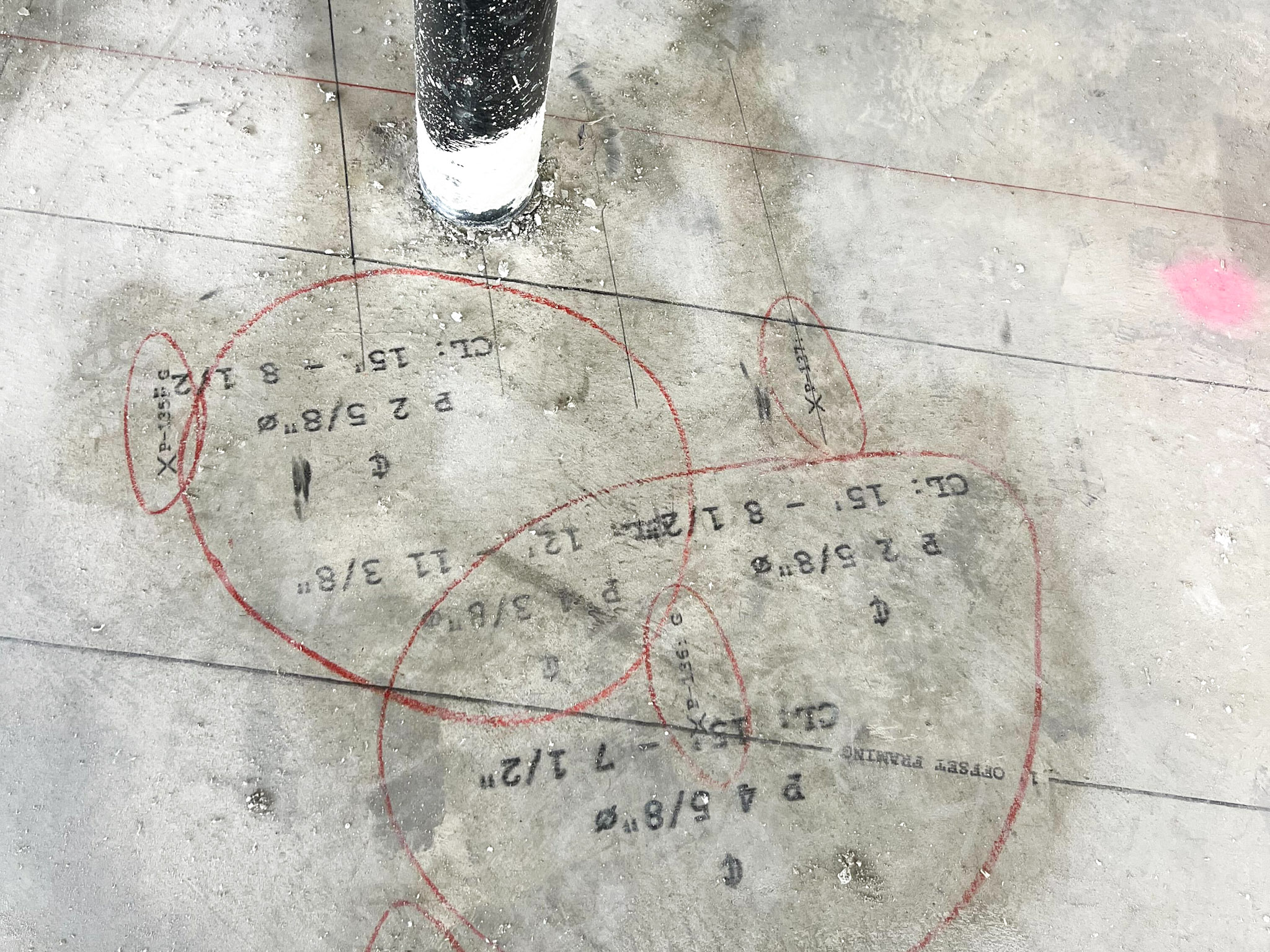
“The benefit is having the layout all done at once,” says Silveira. “We can find conflicts or errors in their scope and ours. It allows everyone to be absolutely accurate and aligned. Dusty helps the plumbers to be in-wall, makes sure the electricians come off the same grid line as us. Everything comes from one source.”
Silveira expands, “Daley’s is always doing our part to pioneer new technology that advances the industry, and Dusty is a part of that.”
Daley’s Changed Layout from a Cost Center to a Competitive Advantage
That insight is translating into a big impact on Daley’s business.
“We track production with a digital production control system which has shown Dusty has saved Daley’s over $300,000 in the last two years in direct labor savings,” says Silveira. That’s to say nothing of the savings realized from reduction of rework, increased productivity for installation crews, and alignment between trades.
“Dusty has saved Daley’s over $300,000 in the last two years in direct labor savings.”
And to the point of those follow-on benefits, Roy says that they realize critical schedule compression benefits. “It's not just the labor decrease, it's the schedule advancement,” Roy says. “If hand layout on a difficult job might take seven to ten days, with Dusty we get it done in two, two and a half days. And at the same time, you lay out the electrician's anchor points while you lay out your walls. That also impacts the schedule.”
VDC Innovation Rooted in the Trade
“I have fun on every job.” Roy loves his work. “I'm a 5th generation carpenter. I came up in the trade. I was my dad's partner for about 15 years.” And as the younger partner, learning new technology was usually his purview. Roy credits “YouTube University” with a laugh when he talks about how he taught himself AutoCAD, and then Revit — skills which ultimately led him to his current role as a VDC leader.
He now describes VDC as a key part of Daley’s workflow. “It’s essential to have preconstruction coordination. It’s a kind of freedom for the foreman to not have to write 300 RFIs before the job can start.”
The capabilities Daley’s has built in VDC help them serve the needs of GCs and Owners as well. “GCs and Owners see VDC coordination as a benefit for their project, especially the more complex ones,” he says, noting that they see the demand for VDC is common especially in health care and education pursuits.
Roy sees Multi-Trade Layout with Dusty as the natural extension of Daley’s investment in VDC. Providing layout services for all coordinated trades is not only a smart efficiency, but is the best way of communicating that coordinated information to field teams who need it to build.

VDC + Multi-Trade Layout + Dusty = Reduced Rework
Roy says that Daley’s is bringing these strategic capabilities together with their partnership with Dusty to build more accurately and reduce rework.
For example, he says in framing “a lot of times when you're laying out walls in repetition, human error is adding up. Dusty removes that error.” That’s a critical benefit for Daley’s within their own scope of work — but it extends to the other trades they’re providing layout for too. That means that Daley’s is delivering outsized value to the GC and Owner.
“When you’re laying out walls in repetition, human error is adding up. Dusty removes that error.”

Daley’s is Transforming the Framer’s Role
Daley’s commitment to the application of Dusty’s technology in their Multi-Trade Layout workflow is bringing foundational change to the role they play as the framer on the project team. Across their project portfolio, Daley’s is delivering greater value to Owners, GCs, and their fellow trades alike.
Silveira remarks that “Dusty is instrumental on all projects, and provides that wow factor to both clients and GCs that may have not yet been exposed to some of the technological advances our industry is going through as a whole. It’s our little robot business partner!”
Dusty Helps Extend Field Careers — and Start New Ones
Roy has up-close, personal experience with manual layout. “I’m not sure everybody appreciates what it takes to do hand layout. You've got one guy reading plans, another guy holding the chalk line. You're walking out 40 feet, you're walking back 40 feet, you're pulling out the tape, you're snapping it back, you're pulling the chalk line out, you're snapping the chalk line, you're double-checking the plans, then you're going back out again, then you're measuring 8 inches, you pull out your speed square. It’s all of those motions, over and over.”
Traditional layout is not only labor-intensive, it also depends on the experience of somebody who's been in the trades for decades. It requires the ability to read complex plans, to pull and mark precise measurements quickly, and the knowledge to recognize issues before they become problems in the field. But Dusty enables junior team members to have that same outsized impact on the job. At Daley's, newer layout operators — early in their careers — are already handling layout with Dusty, freeing foremen to focus on higher-value work and proactive problem-solving.
Dusty has meant that older members of the Daley’s field team have been able to continue to contribute value around layout without risking fatigue injury. “That bending down and kneeling and groundwork…” Roy says, shaking his head. “Dusty is definitely a little easier on the body when you’ve been running drywall for 20-plus years.”
Theodore De La Rosa, Layout Foreman at Daley’s who has been operating Dusty for nearly five years, agrees. “At my stage of my career, I’m happy to be doing this instead of hand layout for sure.”

"Dusty is instrumental on all projects, and provides that wow factor to both clients and GCs that may have not yet been exposed to some of the technological advances our industry is going through as a whole. It’s our little robot business partner!" John Silveira, Construction Manager, head of operations
Interested in learning more about the
Dusty FieldPrinter?




.webp)