How Deacon Flipped the Script on Construction Sequencing to Save $2.5M and Finish Six Weeks Early

As Greater Sacramento grows at an average of 1.25% in recent years (faster than the national average for U.S. metros) healthcare facilities need to keep up. One of the major healthcare providers in the area has been expanding their in-region footprint rapidly as they work to serve the growing community.
Deacon Construction was selected to complete an $18M outpatient center. The 40,375-square-foot progressive design-build project — a tenant improvement in an existing building — featured 75 exam rooms, three treatment rooms, and nine patient education rooms. Adding to the inherent complexity of a medical facility, the building required updates to achieve OSHPD 3 (HCAI 3) compliance as required by California regulation, and the building was partially occupied by other tenants during the build.
How a Layout Robot Changed What an Experienced Team Could Achieve
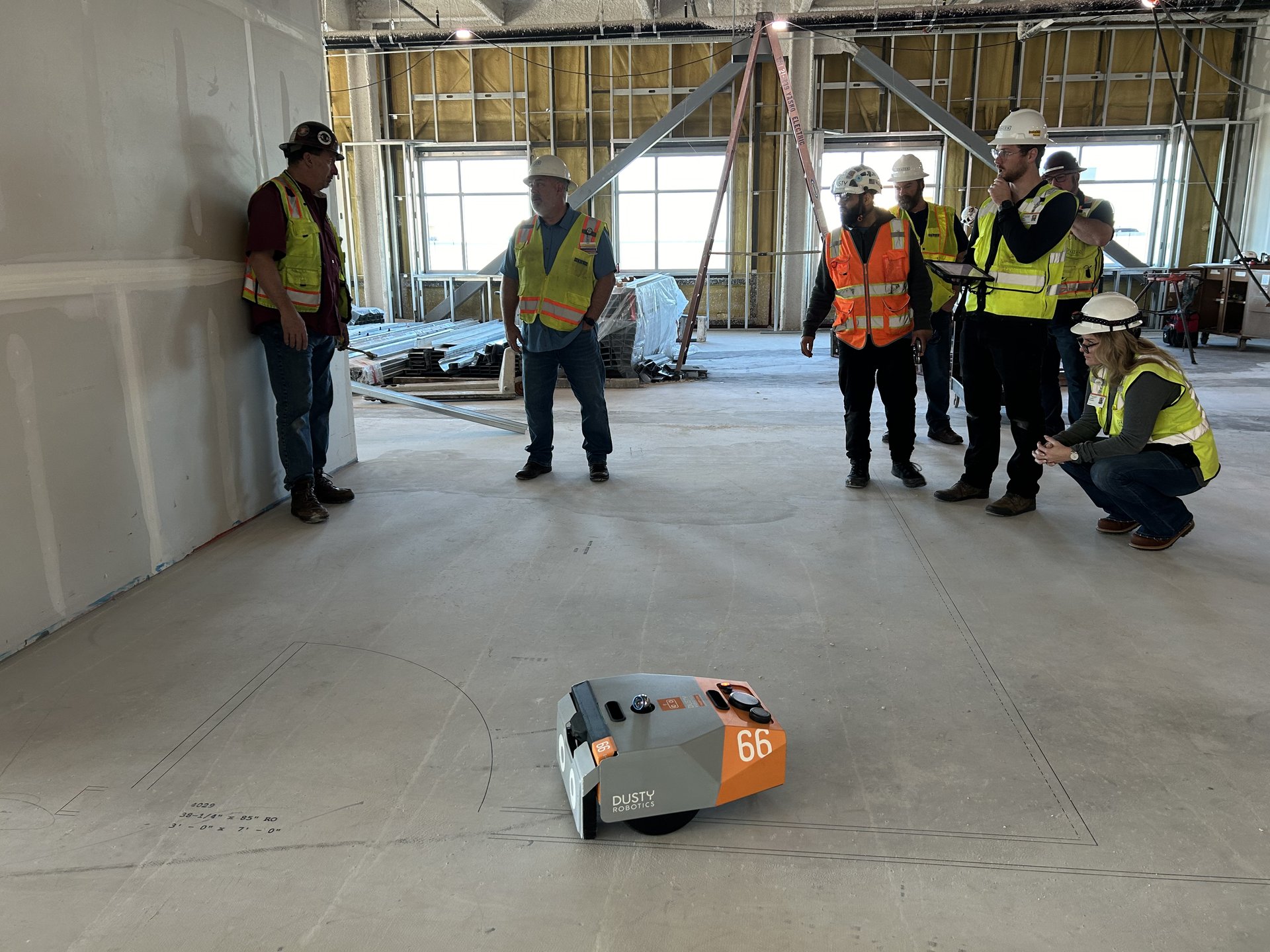
Deacon’s expert healthcare construction team knows how to protect their clients from risk. So they’re laser-focused on heading off any possibility of coordination issues in the constructed work. Even in projects that are scrupulously coordinated during VDC, those issues can creep into the constructed work when trades perform their layout manually, one at a time over the course of the project. The process is inherently prone to error, and so to mitigate that risk, Deacon sequences work carefully to build certainty into areas where coordination really matters — walls go up before overhead work, and so forth.
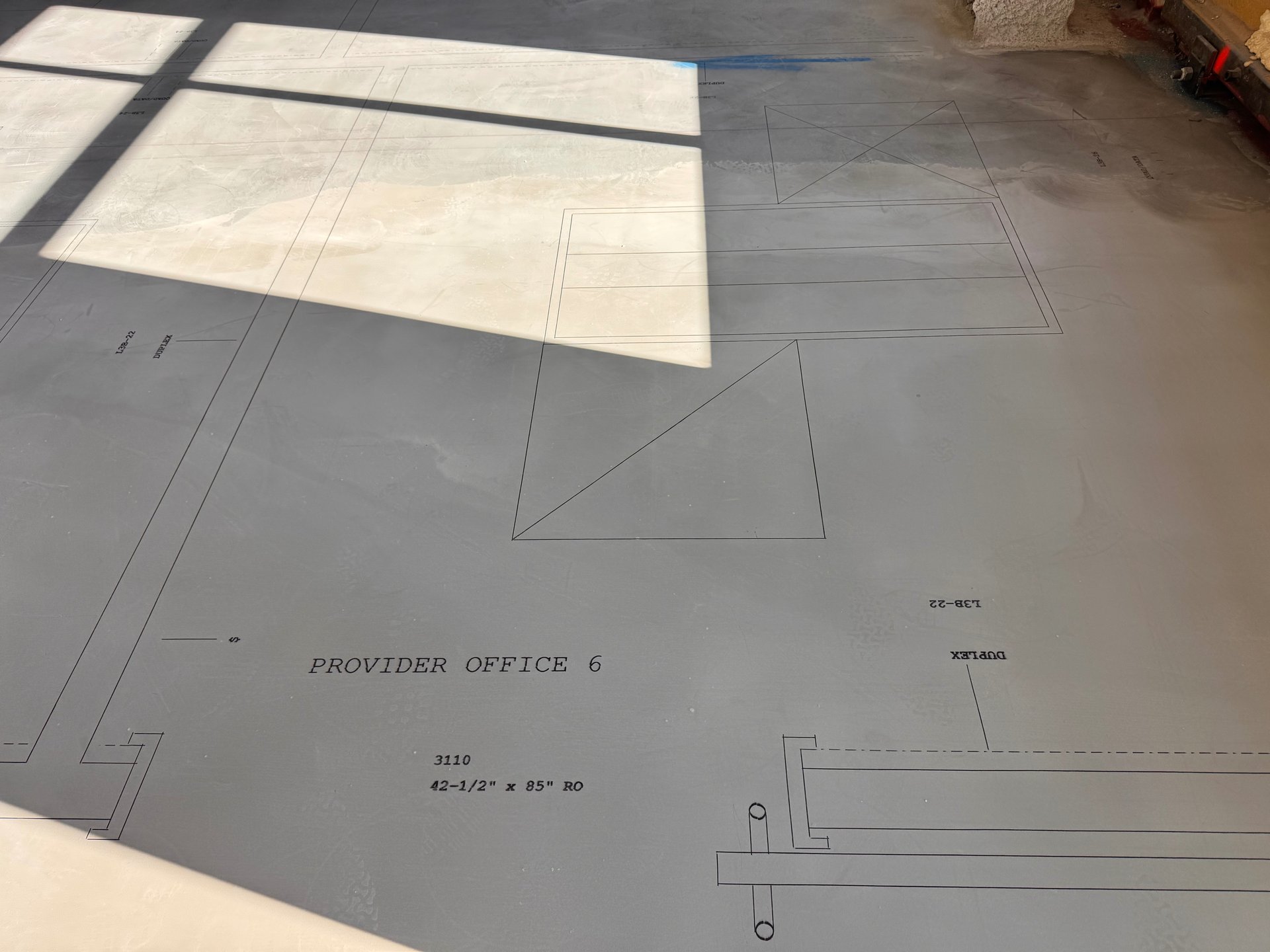
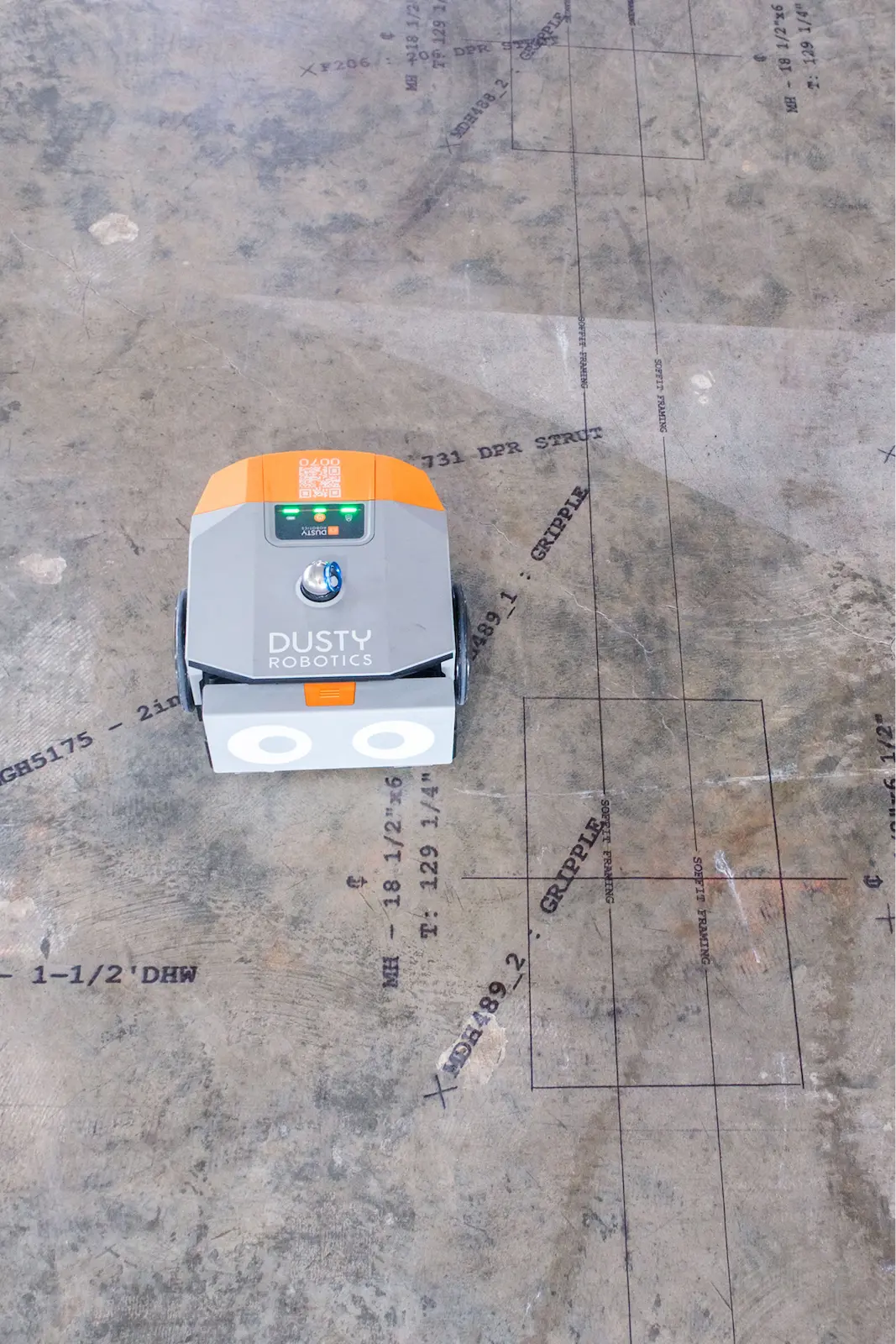
Dusty created an opportunity to produce the coordinated layout for all trades early in the schedule, which created a source of truth for all teams on the project, helping Deacon to facilitate rapid collaboration and drive full transparency.
Chris Helbock, Operations Manager for Deacon, said: “My priority was making sure the layout would be precise enough that our teams could trust it without second guessing. On a healthcare project of this scale and complexity, once we saw the level of accuracy and how it integrated with our coordination process, it became clear this was going to add real value.”
“My priority was making sure the layout would be precise enough that our teams could trust it. Once we saw the level of accuracy and how Dusty integrated with our coordination process, it became clear this was going to add real value.”

That value derived in large part from being able to address field coordination risks with a detailed and trustworthy layout, instead of deriving that risk mitigation from a rigid, linear sequencing of work. As the project team realized the opportunity created in being able to bring outside-the-box strategies to a highly constrained project, they began making decisions and executing work in ways that ultimately resulted in $2.5 million in savings back to the owner and delivering the project six weeks ahead of schedule.
Beyond Automated Layout to Full Multi-Trade Collaboration
The team’s first steps with Dusty were small; on the initial floor, they only laid out walls, rough openings, and some basic annotations. But Helbock said, “Having the room number and name on the floor laid out with Dusty, when you multiply that by hundreds of rooms, that saved time.” The team was quickly catching a vision for the potential, and the excitement was palpable.
Deacon’s team quickly expanded what they printed to encompass not just multiple trades, but a higher level of detail for each: more annotation, outlet locations, data, and even circuit information, all so that trades could execute without constantly cross-referencing drawings, reduce downstream RFIs and simply move faster. Helbock gave one example. "When the electrician walked the jobsite after the layout, they found 15 or 20 outlets and data ports that were in the wrong place. Catching that before installation meant we avoided a whole series of RFIs and potential rework. The architect was onsite, and we were able to resolve in real time, solving the issues while it was still efficient and cost effective.”
As Deacon’s Chief Technology Innovation Officer, Curt Mills, put it, that’s the difference between layout and collaboration: “With multi-trade [layout], it’s high-bandwidth communication; you’re in the location and you’re looking at it together before you build it.”
“With multi-trade [layout], it’s high-bandwidth communication; you’re in the location and you’re looking at it together before you build it.”
Mike Gribble, Project Manager for ACCO, the HVAC trade for the project, sees an additional benefit to multi-trade layout. “Dusty forces the team to have that coordination in advance of mobilization, especially around rough openings and penetrations that would have been left to 'handle it in the field' during installation.” That means HVAC work moves more quickly, and callbacks for the framer to frame out penetrations are eliminated.
Lightbulb Moment: Early alignment unlocked a sequencing shift and saved (the first) $1.5M
That early alignment unlocked one simple but powerful sequencing shift: install overhead work before walls go up.
With framing and HVAC laid out in tandem from the coordinated model, the team realized that for the first time, they had a layout that was as trustworthy as the finished work. They were no longer constrained by the need to install framing first to achieve certainty around overhead scopes of work like HVAC. As a result, HVAC trade contractor ACCO was able to install from a wide open floor before the framer turned the job into a maze of small exam rooms.
Mike Gribble, Project Manager for ACCO, describes the difference from his mechanical contractor’s lens. "Without framing in the way, it essentially turns the space into an ice rink for us.” That simple sequencing change enabled greater speed of install. Gribble continues, "With a big open floor, our team moved around on lifts more than twice as fast as installing [from ladders] or navigating lifts inside of door frames, and our numbers proved that. With the giant floor plate already laid out, everyone that has overhead work is just cruising."
This speed improvement was a big deal. As in, a doubling of production efficiency. Helbock complimented the Dusty team and ACCO, "From the HVAC with ACCO, we saved almost a million and a half dollars. ACCO basically doubled its production from a typical TI project. A good portion of that was because Dusty allowed the HVAC to get in there before the walls were installed." It wouldn’t be the last time the project team won big savings through innovation and tight collaboration.
“From the HVAC with ACCO, we saved a million and a half dollars. ACCO doubled its production from a typical TI project. A good portion of that was because Dusty allowed the HVAC to get in there before the walls were installed.”
The Team Ditched the Ladders, and Kept Safety Incidents to Zero
Those benefits weren’t even the best of the list. Both Deacon and ACCO agree that while the money and schedule savings are great, their top priority is always a safe jobsite — and both agree that the ability to install overhead work from lifts instead of ladders was a major contributor to the project’s zero safety incident record.
Gribble said, "With a clear layout from Dusty in an open workspace, it was easier to maintain pace, easier to stay focused and efficient and people ultimately work safer."
Ryan Tompkins, Superintendent at Deacon, agreed and elaborated, saying "Ladders are the most dangerous thing on the jobsite. Because of Dusty, we could have our HVAC crew install from lifts instead of ladders, and that made them work not just faster, but safer as well. This also kept them from rushing, and that's when safety can get compromised; when teams are behind and in a hurry. When you cut back on the rush factor, it keeps a positive atmosphere, and that’s ultimately a safety factor. Period."
“Ladders are the most dangerous thing on the jobsite. Because of Dusty, we could have our HVAC crew install from lifts instead of ladders, and that made them safer.”

Gribble agreed with those risk factors, adding "If you're trying to get back on track, or you're pushing too hard—which happens often when there's a ton of framing everywhere and things are getting damaged—people are trying to go back and fix things, track back charges, whatever. It becomes more complicated and increases the need to work faster, and that in itself is unsafe."
Dusty isn't layout; it's communication
By the end of the project, everyone was thinking of Dusty as much more than just another jobsite tool for layout. Curt Mills, CTIO, Deacon Construction, gave his thoughts, "Dusty and multi-trade layout, it's super high bandwidth communication. The team doesn't walk over to look at the plans; they look at the floor with everybody right there, and everybody is on the same page."
Tompkins agreed, adding, "with Dusty, construction teams have a clear path that they can trust. This is the way construction should be in the future."
Gribble summed it up: "Standard layout is going to be beaten by Dusty. Dusty is more cost-effective, it's faster, and it's more accurate. And overall, Dusty promotes early collaboration."
“With multi-trade [layout], it’s high-bandwidth communication; you’re in the location and you’re looking at it together before you build it.” Curt Mills, CTIO, Deacon Construction
Interested in learning more about the
Dusty FieldPrinter?




.webp)