"Dusty is not layout — it is quality assurance:" How Level 5 rewired when and how trades collaborate


On most construction projects, trade coordination happens after the problems start
On a typical construction project, trades coordinate reactively. Each trade does their own layout, works from their own interpretation of the plans, and conflicts surface in the field after walls are up and money has been spent.
Level 5 decided to stop working that way. Over the past five years, they’ve partnered with Dusty to completely reimagine their layout process, align their work with other trades, and catch conflicts before they get built into the project.
Want to hear this story directly from the team? Watch now:
Level 5 used Dusty to move coordination upstream, before anyone picks up a tool
When Arturo Richardson, a Senior Project Manager at Level 5, describes what Dusty changed about his company's work, he doesn't talk about speed first. He talks about timing.
"Dusty is not layout — it is quality assurance," Richardson said. "It's all about the input. If the input is not good, the output is not going to be good, regardless of the process."
The Dusty file requires that information be resolved before it can be printed. That's a structural constraint, and it changes behavior. To prepare a Dusty file, Level 5's VDC team works directly in Revit with the coordinated model, engaging with designs and clash coordination from all trades and the GC months before framing begins. Problems that would normally surface during construction get caught during file preparation.
"You're getting all the information you need on time and asking the right questions before any issues pop up," Richardson said. "You get to see a lot more issues than what your guy in the field would be seeing just from the layout aspect of it."
That upstream shift isn't just visible to Level 5. Derek Kersey, an Office Engineer at Hensel Phelps who works with Level 5 on a recent project, sees the same thing from the GC's side. "It's super important for the GC because we want to get people thinking," Kersey said. "We want people ahead of the game before we're out here in the stage where walls are going up."
“It's super important for the GC because we want to get people thinking. We want people ahead of the game before we're out here in the stage where walls are going up.”


The coordination change also transformed what happens on the floor. Where a crew of four or five once spent days snapping chalk lines, one operator now covers the same ground in a third of the time, printing far more detail: both sides of the framing, drywall finish, door arrows, soffits, and ceilings. Steven Depee, a framer at Level 5 who has operated the robot for nearly three years, sees the result when it's time to build. "We don't have to move any walls," Depee said. "The layout is where it's supposed to be, and when we frame it, that's where it stays. Nothing needs to be moved." On a recent project, his calibrations held within 1/32 of an inch across the entire floor, twice as good as Dusty's spec'd accuracy of 1/16 of an inch.
Other trades didn't adopt a robot. They adopted Level 5's coordination process.
As Level 5's Dusty practice matured, other trades on the jobsite started seeing the additional detail printed on the floor and asking how to get their own scope into the file. HVAC contractors, plumbers, and glaziers weren't buying a robot. They were opting into a coordination workflow that Level 5 had built around Dusty: resolve your information early, get it into the model, and let it show up on the floor alongside everyone else's work.
Francisco Sandoval, a General Foreman at Level 5, described the pattern from the field: "They start asking questions like, 'How did you guys get that? Can I put that on your file?'"
His response was straightforward. "The more information we can put in the file, the better for everyone," he said.
The result is that Level 5 is no longer just executing their own framing scope. They've become the trade that other trades coordinate through. Door rough openings, can placements for plumbers, duct locations for mechanical trades: all of it flows through Level 5's Dusty file and lands on the concrete alongside their own layout.
On a recent project with Hensel Phelps, the GC started routing trade coordination through the Dusty file
On one of Level 5's current projects, a major medical and research facility in San Francisco being built by Hensel Phelps, the coordination model has gone a step further. The GC has made Level 5's process part of how they manage the project.
"My involvement has been coordinating and making sure all that information is in Dusty, not just from the Level 5 team, but from the other trade partners, incorporating their information into the Dusty file so we can get it printed out here on site," Kersey said.
The payoff: trades can see their work in context long before they're scheduled to be on site. "I had an interior glazer come out here and they were able to see the dimensions of their openings on the ground, their work in place maybe half a year in advance of when they're actually out here," Kersey said.
When coordination moves early enough, you can build off site with confidence that everything fits
The most striking example of where early collaboration leads is happening on the same project. The building includes specialized laboratory spaces requiring complex plumbing systems, including reverse osmosis lines with welded connections that demand shop-grade equipment. The equipment wouldn't fit in the tight spaces on site.
"The equipment would not fit on the jobsite to do certain welds and joineries for systems like reverse osmosis," Richardson said. "So what we did with Dusty and the plumber was coordinate the openings that needed to be done for every cassette condition."
Level 5's solution was to take the entire process off site. The team went to the plumber's shop, used Dusty to lay out the framing for modular wall cassettes, and built them there. The plumber completed all rough-in work using specialized shop equipment, including laser-cutting top track pieces to match exact penetration locations. Once the cassettes were finished, they were trucked to the jobsite and installed.
This wasn't a one-off experiment. The project calls for around 250 of these cassettes. Every single one is being prefabricated off site and brought in.
"We laid [250 cassettes] out with Dusty, built them, and then we brought them on site. They fit perfectly. We grab them, slide them into place, screw them in, and walk away."


The reason it works is the same reason everything else in this story works: the coordination happened early enough that every trade knew exactly what they needed to build, exactly where it needed to go, and exactly how it connected to everyone else's work.
"We laid them out with Dusty, built them at their site, they completed all the rough-in, and then we brought them on site. They fit perfectly," Richardson said.
And when the cassettes arrive, the installation tells you everything about how much work happened upstream. "We grab them, slide them into place, screw them in, and walk away," Richardson said.
Level 5 changed their role on the jobsite, not just their layout process
The transformation at Level 5 isn't about a robot. It's about when collaboration happens, who drives it, and what becomes possible when a trade contractor decides that coordination is part of their job, not just a step they wait for someone else to manage.
"Dusty is one of the greatest innovations in layout recently," Richardson said. "We're all about being at the forefront and using anything that can help not only our team but our client."
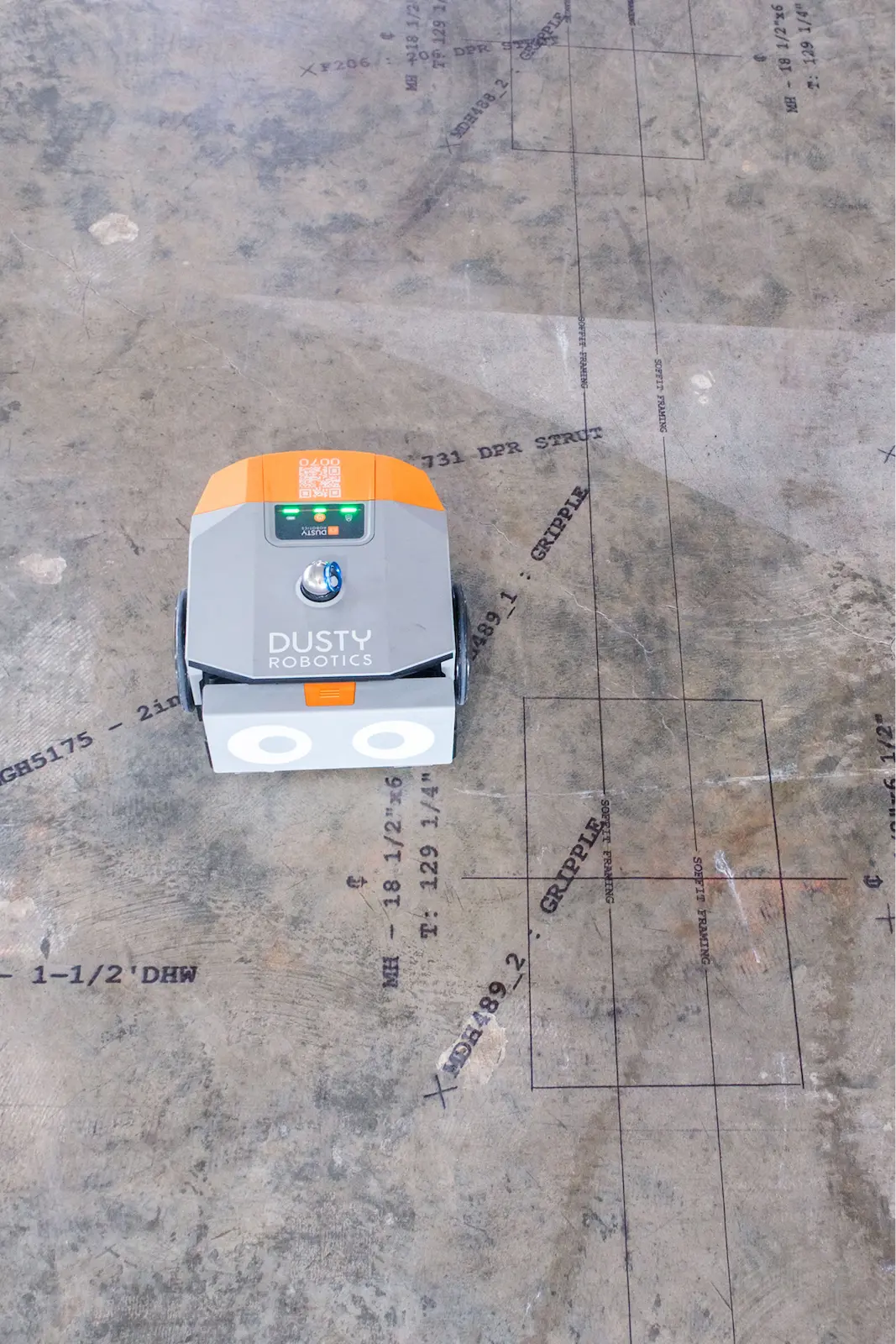

"This was by far my most accurate job that I've ever done." — Steve Depee, Framer, Level 5 Inc.
Interested in learning more about the
Dusty FieldPrinter?




.webp)