Skanska Uses Dusty to Drive Speed and Alignment in Two Complex Healthcare Projects

Skanska appreciated the opportunity to simultaneously deliver two unique projects, and the team was ready to plan and deliver on client expectations. “Our team looked at our previous Sutter projects and knew we had a variety of creative and innovative solutions we could implement on the new ones. For example, we made sure to co-locate Skanska Project Management across both projects, to create continuity and consistency for our team and client.” That’s David Sharkey III, Sr. Project Manager at Skanska, describing how Skanska’s creative approach helped ensure the team was prepared to be an integrated partner to these closely connected programs on two different project sites.
The result was two sister projects, both delivered using an Integrated Project Delivery (IPD) process:
- Willow building: A 60,000 sq ft adaptive reuse project converting an old telecom warehouse into an outpatient surgical center and medical office building (MOB). With specialties ranging from orthopedics and podiatry to casting, audiology, and gynecology, the program demanded extreme coordination to accommodate diverse medical needs and California’s strict seismic codes.
- Hopyard building: A two-story building with Skanska building out the first floor — over 20,000 sq ft — into a pediatric urgent care, physical therapy facility, and full-service imaging center housing MRI, CT, DEXA, mammography, and ultrasound.
In short, Skanska was onboard to provide certainty of delivery. There was no room for error.
Multi-Trade Layout Changed the Game
For Skanska, Multi-Trade Layout is a core part of how they plan and build healthcare projects across the region. It helps align trades, eliminate conflicts, and connects crews to model information in format they can use, so Skanska delivers predictability, quality, and cost efficiency to owners.
After investing heavily in BIM and coordination, Skanska found that traditional layout methods couldn’t deliver the accuracy needed.
“We’re designing to an LOD 400 level,” said Joe Weisman, Project Manager. “All our MEP systems, wall systems down to stud spacing, seismic bracing, specialty medical equipment like Steris booms, overhead lighting — it’s all modeled, and to very tight tolerances.”
It would be nothing short of tragic for that work to not get faithfully reproduced in the field. “We couldn’t risk the design not getting successfully communicated to the field,” said Weisman.
“We’re designing to an LOD 400 level. We couldn’t risk the design not getting successfully communicated to the field.”


To avoid that risk, the team settled on a Multi-Trade Layout approach.
“On other projects, a lot of times there’ll be clashes in the field, and my first instinct is to say, ‘Have we checked the model?’” says Weisman. “Because nine times out of ten, it’s already been worked out in the model, and we need to leverage that information as much as possible.”
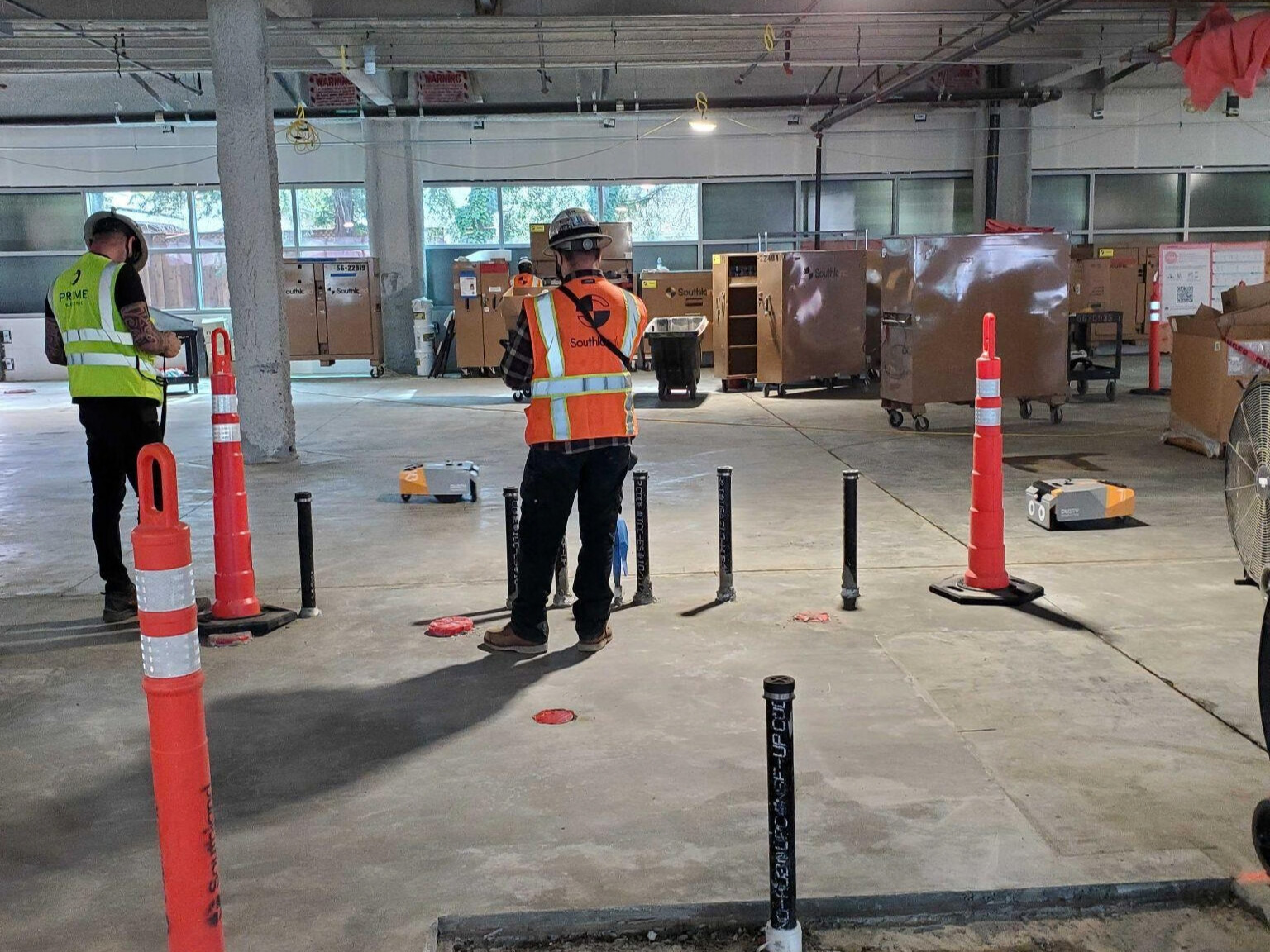
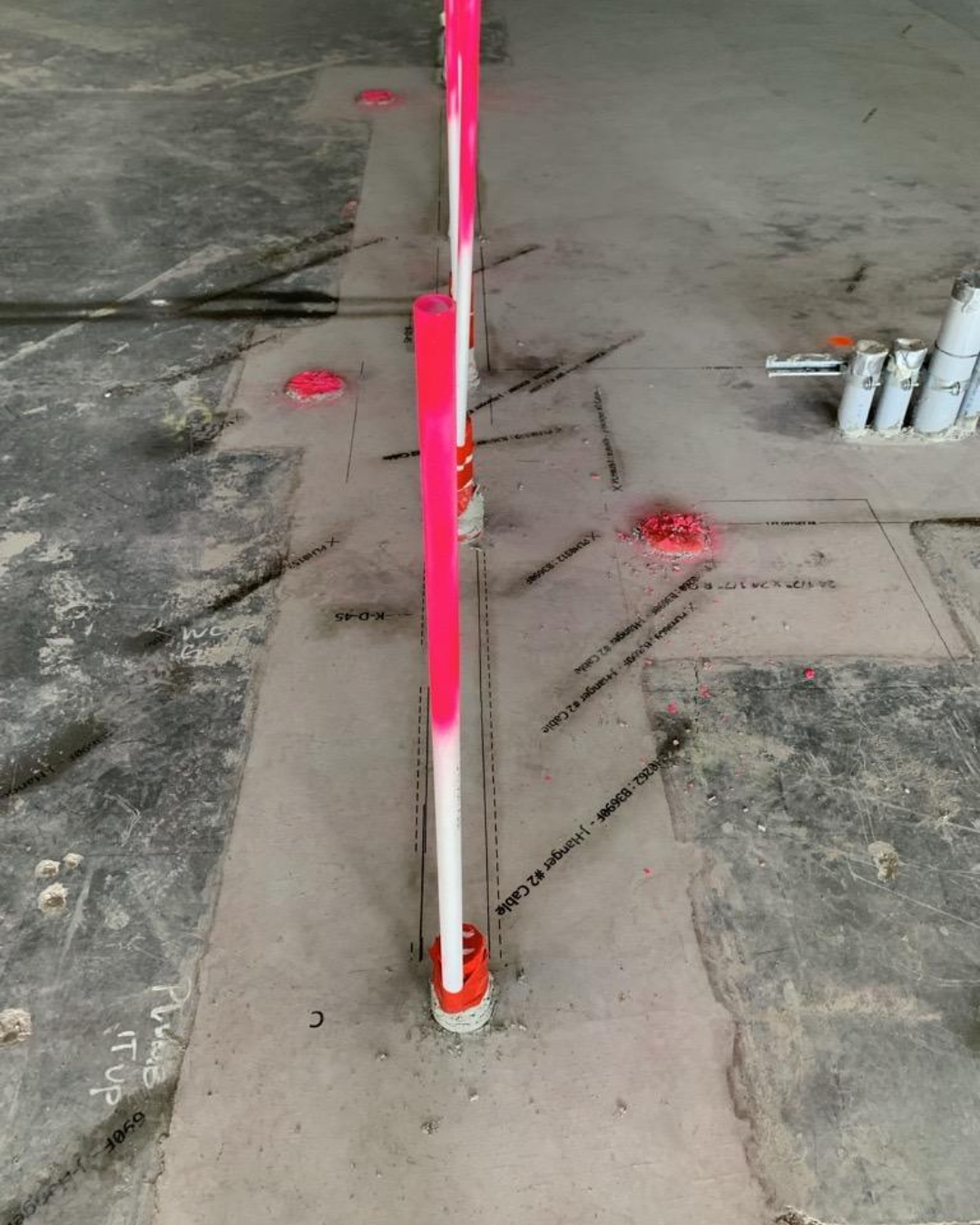
Instead, they pursued a Multi-Trade Layout approach: a workflow innovation that turns traditional layout on its head. In Multi-Trade Layout, the GC and trades work together to coordinate layout as a digital deliverable as part of VDC. Then, everybody’s layout is printed onsite in a single pass with Dusty. This collaborative, all-at-once approach gets everybody aligned early and creates a direct connection between coordinated model information and installation execution in the field.
“With a Multi-Trade Layout approach, deviation is drastically reduced. It’s increasing the fidelity of our installation to the model,” says Weisman.
One-Inch Tolerance in the Sterile Corridor
One of the most technically demanding areas was the sterile corridor inside the outpatient surgical center.
“We had coordinated everything to a 1-inch tolerance throughout because of all the risk factors. For example, it’s a wood-framed building, so we weren’t able to do a return air plenum. So we had large trunk HVAC systems, med gas racks, e-power, conduit, building power… all of that had to fit through this narrow corridor that served all the ORs,” Weisman recounts.
Having invested so much effort in coordination, it was essential that the installation match the model exactly — or that investment would have been wasted.
“With Dusty, we were able to reduce our risk because we laid out exactly what we had done in the model,” says Weisman.
“With Dusty, we were able to reduce our risk because we laid out exactly what we had done in the model.”
From Risk Exposure to Risk Mitigation
Skanska’s approach to Multi-Trade Layout with Dusty brought several key outcomes.
Early Team Alignment
“Dusty’s technology introduces a process that makes so much logical sense. We want to have a fully coordinated model before we even start on a project site. But that’s actually pretty hard to do,” says Sharkey. “We’re pushing Multi-Trade Layout as the reason to get coordination done early. Because there’s a lot of value [in Multi-Trade Layout] that we can share with the team. Less rework. Predictable schedules, predictable costs.”
Weisman agrees. “It increases the collaboration between those core trade partners. The technology brings everybody in.”
“Dusty’s technology introduces a process that makes so much logical sense. We’re pushing Multi-Trade Layout as the reason to get coordination done early. There’s a lot of value [in Multi-Trade Layout] that we can share with the team. Less rework. Predictable schedules, predictable costs.”

Installation with Fidelity to the Model
Multi-Trade Layout is “making sure the dry-run we did during our VDC effort is actually being utilized and realized in the field,” says Weisman.
He acknowledges that it’s hard to estimate the amount of rework that didn’t happen. But Skanska estimates that they’ve seen 75% less rework on projects leveraging Multi-Trade Layout, compared to similar projects using traditional layout.
).png)
Project Acceleration
Dusty’s platform helped transform layout from a bottleneck into a collaboration tool that accelerated construction. “It was worth every penny,” says Weisman. “It allowed us to condense our layout schedule.” In fact, Skanska realized a 35% reduction in layout schedule on these projects, to say nothing of the additional installation efficiencies they gained.

"There’s a lot of value [in Multi-Trade Layout] that we can share with the team. Less rework. Predictable schedules, predictable costs.” — David Sharkey III, Sr. Project Manager, Skanska
Interested in learning more about the
Dusty FieldPrinter?




.webp)