The Invisible Bottleneck Slowing Down American Manufacturing


American manufacturers are retooling faster than ever. Automotive suppliers are expanding. New production lines go in while old ones get reconfigured. But layout — the critical step in which design information is moved to the floor for installation — is stuck in the past, insufficient to meet the needs of modern industrial projects.
Every time new equipment goes in, somebody has to mark the floor. Footplate locations, base plate positions, bolt patterns, alignment references. At most facilities, that work is still done by hand with chalk lines and tape measures. It takes days. It's imprecise. And every day spent on layout is a day the production line isn't running.
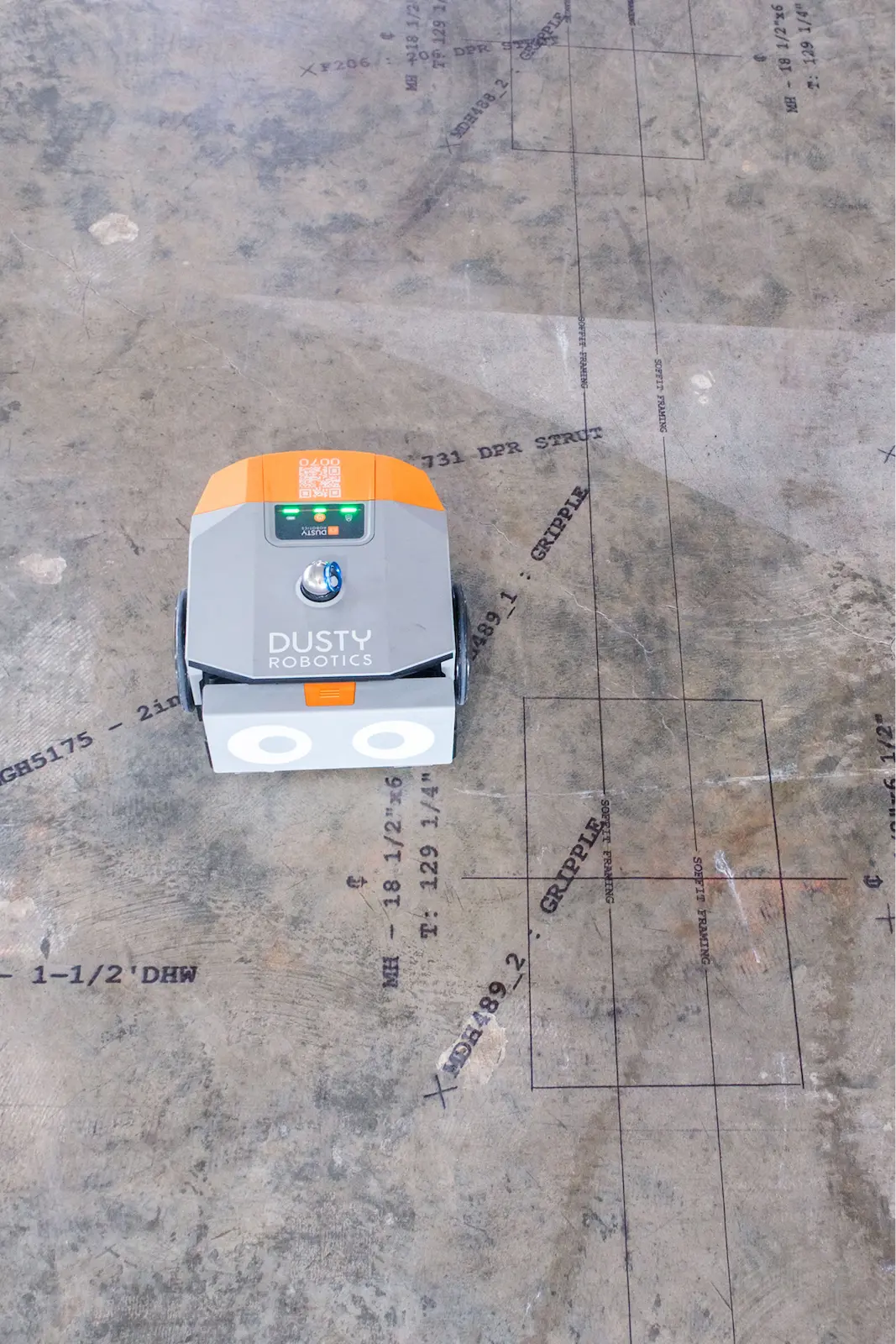
Bouma Corporation set out to fill that gap. Using Dusty's robotic layout platform, Bouma now prints machine positions, bolt patterns, torque specs, and QR-coded work instructions directly onto factory floors. They've completed roughly two dozen industrial layout jobs across automotive, data center, and rack manufacturing facilities, and the demand keeps building.
A 30-year construction relationship opened the door to a completely new market
Bouma didn't set out to become an industrial layout provider. They stumbled into it through a relationship with an industry-leading automotive supplier based in Michigan that goes back over 30 years. When Bouma started using Dusty on construction projects at Gentex facilities, the factory's engineers saw the robot and immediately recognized what it could do for their equipment installations. "Their engineers see what Dusty's doing and it's a no-brainer," said Tim Bauer, Bouma's Manager of Construction Innovation. "'You could lay out all these footplates, just like that.'"
Bauer gave them a quick pitch. They took it back to their engineering team, and the response came fast: "The conversation I got back was, 'We could do all of this in a lot shorter amount of time,'" he said. That pattern has repeated at factory after factory since. Manufacturing operations teams live and breathe cycle time, throughput, and cost-per-unit. They don't need to be convinced that faster, more accurate layout is worth pursuing. They see the robot, understand the value, and start finding projects. Bouma doesn't have to sell the concept. They just show up, print, and let the results do the talking.
If you'd like to learn more about how Bouma built their layout service offering around Dusty, read this story.

The real value isn't faster layout. It's richer information on the floor.
Speed matters. But the shift that actually changes how factories install equipment is the depth of information Bouma can put on the floor. A chalk line tells an installer where to place a machine. A Dusty print tells them where to place it, how to orient it, which bolts to use, and how tight to torque them.
The process starts with the factory's engineering team, who prep the CAD file with whatever their installers need: footplate locations, bolt patterns, crosshairs, torque specs, assembly references. Bouma takes that file, aligns it for printability, and shows up to print. "They provide us the file, we take that file, we bring it into our workflow, we make sure it's gonna print correctly, and then we show up and print it," Bauer said.
“We ask them to prep the file the way they'd like to see it. They own the content; we make sure it prints right. [We tell them to] think about anything that would help your installer. You want to give the most critical, highest-value information.”


The division of responsibility is deliberate. The factory owns the content. Bouma owns the execution. "We ask them to prep the file the way they'd like to see it," Bauer said. "Then we have a handoff meeting and make sure all the information lines up so you can read it when you hit the jobsite. They own the content; we make sure it prints right." That clean split means Bouma never takes on liability for the engineering decisions in the file, and the factory owners get exactly the information they specified, printed at a level of accuracy and detail that manual layout can't touch.
The philosophy behind all of it is simple. "Think about anything that would help your installer, and work it back from there," Bauer said. "You don't want to get too crazy with the information, but you want to give the most critical, highest-value information."
QR codes on the floor turned the slab into a live reference library
On some projects, the information goes beyond what's printed in ink. Factory owners have started requesting QR codes next to each piece of equipment. When an installer scans the code with their phone, it links to the factory's own documentation: assembly instructions, wiring diagrams, specs. The factory controls what's behind the code. When something changes, Bouma updates the QR code without reprinting the floor.
"On some jobs, the factory requests that we put a QR code for each unit being installed," Bauer said. "When their installers scan it, it links to a URL that the factory's engineering team has created — assembly instructions, specs, whatever they need."
“We put a QR code for each unit being installed. When installers scan it, it links to a URL that the engineering team has created — assembly instructions, specs, whatever they need.”
This is a small detail that reveals a larger shift. The factory floor is becoming an information layer, not just a surface to build on. Layout used to be a set of marks that told you where things go. Now it's a communication platform that tells installers what to do, how to do it, and where to find the documentation if they need more.
At a rack manufacturing facility, three units were installed in a day instead of one
The clearest proof of what this means for production timelines came at a rack manufacturing facility in Middlebury, Indiana. Normally, the facility's team would lay out one manufacturing unit by hand and install it. One unit per day.
When Bouma printed three units in a single day, the installers installed all three. The throughput gain wasn't about Bouma being fast. It was about the information on the floor being complete enough that installers could skip the usual search-and-verify cycle. "They typically lay out one unit and install it in a day," Bauer said. "I got three units laid out in a day, and they were able to install all three — not because I completed three, but because the information on the floor was clear enough that their guys could just set the unit down, put it where it needed to go, and move to the next one."
“They install [one unit] in a day. I got three units laid out in a day, and they were able to install all three — because the information on the floor was clear enough that their guys could just set the unit down and move to the next one.”
That's a 3x throughput improvement driven not by faster hands but by better communication between the design and the floor. The key isn't printing more lines. It's printing the right information so that the installer has everything they need at their feet, not buried in a drawing. The best layout file isn't the most detailed one. It's the one that puts the right information in front of the right person at the right time. For a factory owner, the math is straightforward: every day saved on layout and installation is a day closer to production.

Two dozen factory jobs and counting, built on a repeatable process
Bouma has now completed roughly two dozen industrial layout jobs. Six or seven at the automotive supplier alone. A month and a half at Tesla. Projects in Middlebury, Indiana and Omaha. "It's just been that kind of snowball effect where we're now getting more and more industrial automation layout requests," Bauer said.
The work scales because the process is simple. The factory provides a file, Bouma preps it, Bouma shows up and prints. Bouma has formalized this into an innovation department that manages layout and 3D scanning services both internally and as external offerings. For factory owners, the value proposition is that they don't have to build this capability themselves. They hire Bouma the same way they'd hire any contractor: scoped work, clear deliverables, repeatable results.

Automated layout is how the next generation of factories will get built
The reinvention of American manufacturing isn't just about new machines and new production lines. It's about how quickly and accurately those machines get placed, connected, and running. Layout has always been the invisible bottleneck in that process. Nobody talked about it because there was no alternative to doing it by hand.
“It's not just a guy laying out lines. It's the next level of information on the floor. It's getting the automotive industry set up and poised to do their job better.”
Now there is. And the factories that adopt it aren't just getting faster layout. They're getting richer information on the floor, tighter installation timelines, and a direct line from the engineering model to the installed equipment. That's not a marginal improvement. It's a structural change in how industrial projects get delivered.
"It's not just a guy laying out lines," Bauer said. "It's the next level of information on the floor. That information is so valuable — it's getting the automotive industry set up and poised to do their job better. It's taking layout to a next level of, this is a lot of value on the floor."

Interested in learning more about the
Dusty FieldPrinter?




.webp)