Bouma Corporation Didn't Just Automate Layout. They Built a Business Around It.


Most contractors treat layout as a cost they manage. It's a line item on a schedule, a task somebody has to do before the real work starts. Nobody puts it in a bid proposal.
Bouma Corporation used to see it the same way. Then they got Dusty. Over the last four years, what started with a single robot on a jobsite has become a new revenue stream, a competitive differentiator in bid pursuits, and the foundation of an entirely new department. The shift was driven from both ends: senior leadership made the bet early, and field crews pushed the boundaries of what they were doing with the technology far beyond anyone's original plan.
Today, Bouma uses Dusty on almost all of their projects. They offer Multi-Trade Layout as a service. And they've fundamentally changed what kind of company they are.
Layout used to be a chore nobody thought twice about
Tim Bauer, Bouma's Manager of Construction Innovation, knows what layout used to look like.
"It's a tedious thing to crawl on your hands and knees, snap lines, stack numbers, do the conversions," he said. "That was just the reality of layout."
Foremen did it because they had to. And because it was time-intensive, they marked out the bare minimum information. Nobody was laying out finishes, door swings, or specialty details because the payoff didn't justify the effort. At the company level, layout was invisible. It wasn't a topic in leadership meetings or bid strategy conversations. It was overhead, and the only goal was to get through it as fast as possible.
The field saw it once, wanted it immediately, and then kept pushing it further
Bouma started using Dusty in late 2021. Tim brought the robot to a jobsite for the first time, and the reaction was the first sign that innovation was going to come from the field, not the front office.
"The first time I brought it out, we had five of our foremen out there, and all five of them had their phones out, watching it live," Bauer said. "Every one of them was like, 'When can I get this on my jobsite?'" These were veteran foremen who had spent years doing layout by hand. What they saw wasn't just a faster way to snap lines. It was a tool that could communicate more information to their crews than ever, and they immediately started thinking about what else it could do. Within months, the conversation shifted from curiosity to dependency. "It's turned into, 'I need Dusty out here because I can't get the job done in time without it,' or, 'I need Dusty out here because it's too detailed and I don't have the time to spend on my hands and knees doing all this,'" Bauer said.
“Every one of [our foremen] was like, ‘When can I get this on my jobsite?’ It’s turned into, ‘I need Dusty out here because I can’t get the job done in time without it.’”


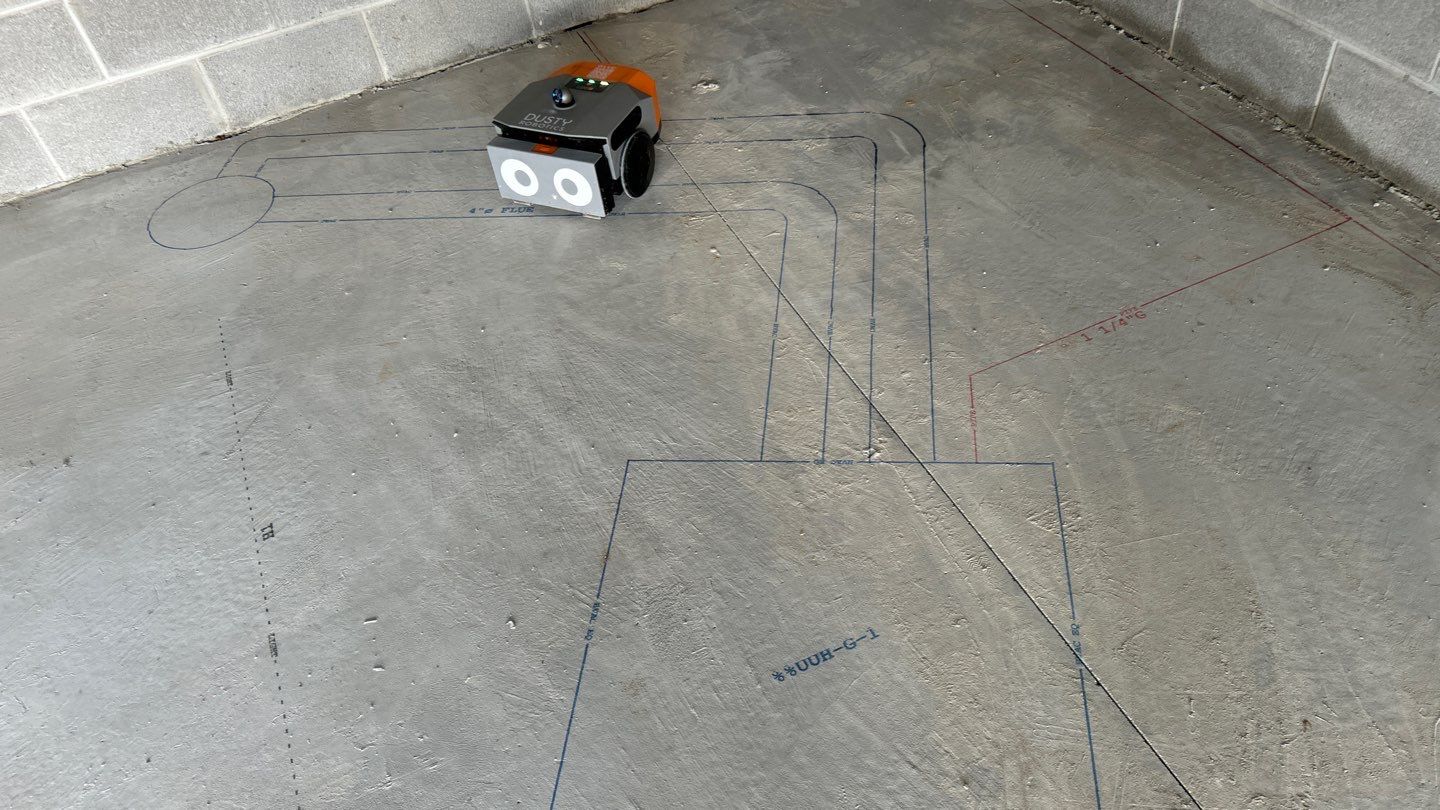
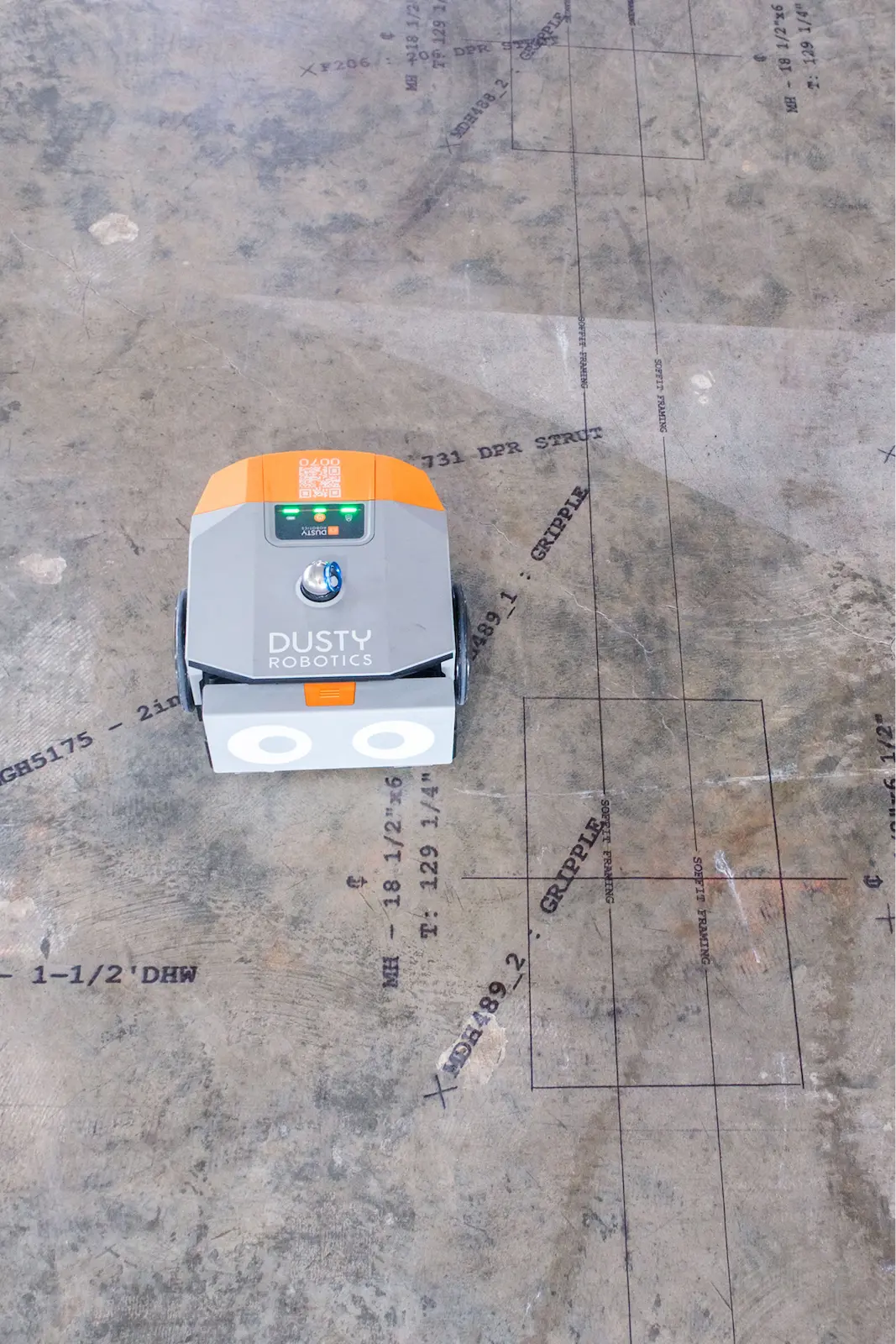
Bouma's leadership gave the field teams room to experiment, and the crews ran with it. "Once we realized Dusty can do anything on the drawing, we started using it to lay out our doors, the way the door swings, our hollow metal frames," Bauer said. "Then we realized we could put the information for the handle sets, and our crews can just go in there, read the floor, see what needs to be installed, and install."
They even printed radius lines for drywall cloud ceilings directly onto sheets of drywall, then cut and installed them. They added QR codes linking to jobsite-specific details so installers could scan a code on the floor and pull up the exact detail for that building component on their phone.
"Our guys do a really good job of thinking outside the box and just asking the question: could Dusty lay this out?" Bauer said. "95% of the time, the answer is yes."
This is the culture Bouma built. Leadership created the conditions by making the investment and trusting the field. The field delivered by refusing to stop at the obvious use case.
Every trade's information was already in the file, so Bouma turned that into a business
The next leap wasn't a technology upgrade. It was a business model innovation. When Bouma received a CAD file for a project, every trade's information was already in it, not just framing. Tim had a simple question that changed the trajectory of the company.
"When you get the CAD file, everything's in there," Bauer said. "I'm like, why are we taking it out? Let's print it."
That question turned layout from Bouma's own internal process into a service they could sell to every trade on the project. To prove the concept, Bouma developed what they call "demo rooms."
"We'll pick a room on a jobsite and print everything," Bauer said. "Then we bring those contractors in and say, 'Here's what we could do for you. Are you interested?' "
The benefit was immediate. "They didn't have to find the piece, locate it on the drawing, then locate where it goes in the building," Bauer said. "It was just: find the piece, look at the floor, install. It skipped those steps entirely."
The demo room wasn't just a cool idea. It was a go-to-market strategy for a new line of business.

Automated layout changed the kind of company Bouma is
By the end of 2022, Bouma was putting automated layout in every bid proposal. This wasn't just about winning more work. It was about showing up as a fundamentally different kind of contractor, one that competes on capability rather than lowest price.
"We started putting in our bid proposals that we offer automated layout to support the job," Bauer said. "We saw a definite uptick in being moved to the top of the bid pile. It helped us land projects where we probably would have been passed over for the lowest bidder."
“We started putting automated layout in our bid proposals. It helped us land projects where we probably would have been passed over for the lowest bidder.”
Dusty also opened up new project types. At the Helen DeVos Children’s Hospital, Bouma went after a flooring scope with a complex radiused design, and won. "We went after a flooring project with a lot of radiuses and swoops, something we would typically pass on because our flooring department's not that big," Bauer said. "But now that we have Dusty, those avenues have opened up."
Bouma has even started offering automated layout services to industrial manufacturing facility owners and builders. Read more in this story.
"For our leadership to take the step of partnering with Dusty, it made us the industry leader in automation," Bauer said. "There was no one else here."
A GC hired Bouma specifically for layout, not framing
The clearest proof of Bouma's transformation came on a project for The Church of Jesus Christ of Latter-day Saints in Grand Rapids. One of the key reasons that the general contractor selected them for the framing scope of work was because Bouma was also able to provide multi-trade layout as a service — a huge value add.
"The GC reached out to us because we have Dusty," Bauer said. "They bought out the rest of the layout scope and hired us to do it. We gave them a proposal for all the layout, and they sold it right back to us."
Bouma laid out everything on that 17,000-square-foot building: all MEP trades including all electrical, HVAC, and plumbing. Sixteen days of layout. The same GC has since asked Bouma to put together proposals for two more similar projects.
This is what transformation looks like. A company that was hired for drywall and metal stud is now being sought out for an entirely different capability. Tim sees this as the model for where the industry is headed.
"I would love for every jobsite to be that way, the GC keeps the layout scope and those dollars, and hires an automated layout service to do the work," he said.
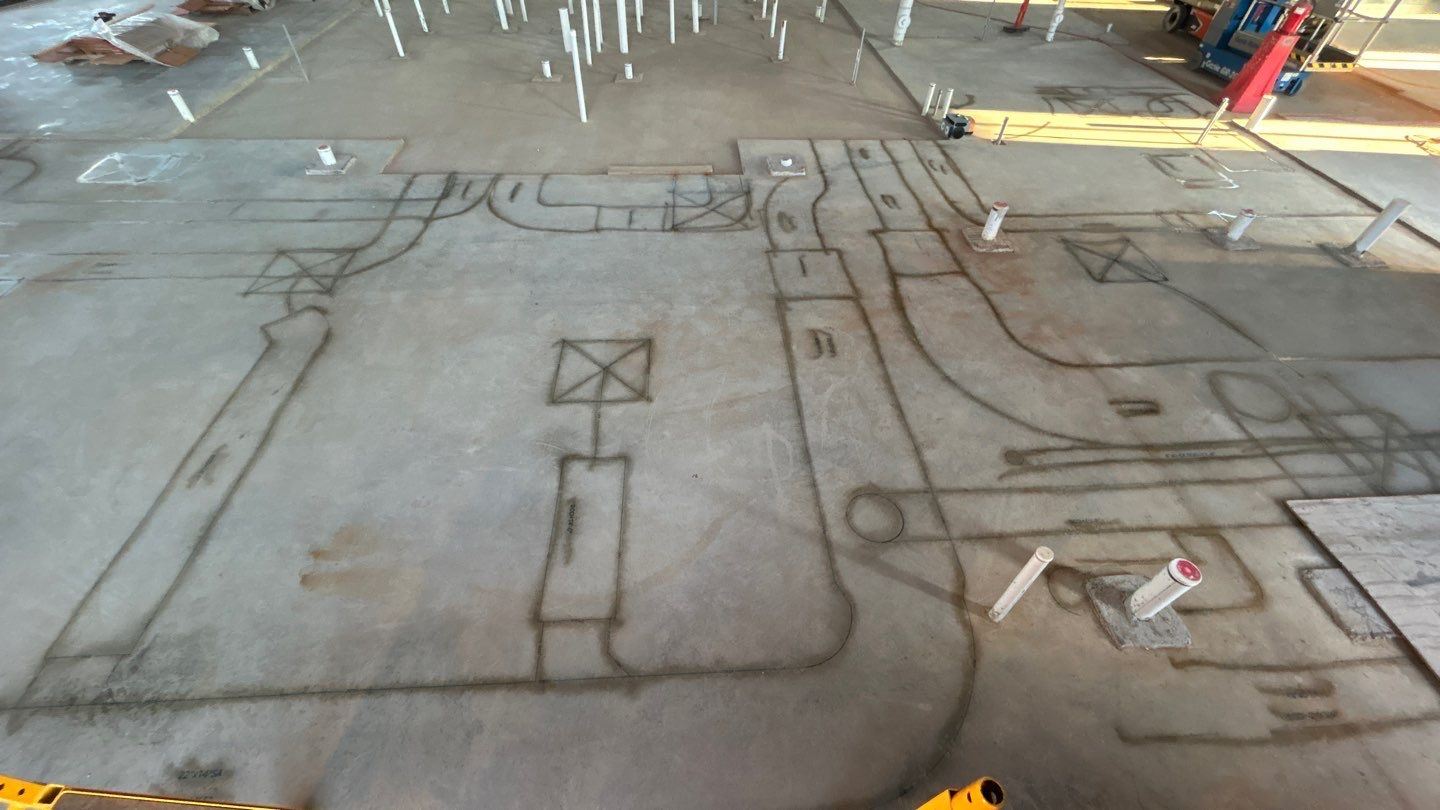
Bouma didn't just adopt a tool. They built an organization around it.
Bouma now runs Dusty on almost all of their projects. But the real signal of transformation isn't the usage number. It's the fact that they created an entirely new department to institutionalize what they've built.
"90% of our jobs are Dusty jobs," Bauer said. "We bring it on the small ones, the big ones, the really large-scale ones."
"We have an innovation department that's taken on selling Dusty layout work and 3D scanning outside the company, and also using those tools to support Bouma internally," he said.
“90% of our jobs are Dusty jobs. We bring it on the small ones, the big ones, the really large-scale ones. We have an innovation department that's taken on selling Dusty layout work outside the company.”
An innovation department isn't something you create for a tool you're trying out. It's something you create when a capability has become central to your business strategy. And when your business depends on a platform, the platform matters. Bauer has seen other robotic layout product on jobsites and spoken directly with operators using them. "HP is trying, but they're way behind," he said. "The technology is clunky. For example, HP doesn't have the line styles." Bauer talks about why Dusty's custom line styles feature is so important to the team: "Our installers tell me, 'Now I know it says framing, and that's where I go.' It takes the questioning of 'is this my line or not?' out of it." And Dusty's subscription model means ink, repairs, and troubleshooting are covered. "I need more ink? Got it. I need a repair, they're overnighting it. I need troubleshooting right now, here it comes," Bauer said.

Layout went from overhead to one of Bouma's biggest differentiators
Four years ago, layout was something Bouma's foremen did on their hands and knees before the real work started. Today, it's one of the company's most important strategic assets. That shift didn't happen because of a single technology decision. It happened because Bouma's leadership had the vision to invest early, and their field teams had the curiosity and drive to push the technology far beyond its original scope.
"It's not just a guy laying out lines," Bauer said. "It's the next level of information on the floor. That information is so valuable, it's taking apprentices and turning them into journeymen quicker. It's taking layout to a next level of, this is a lot of value on the floor."

"Partnering with Dusty, it made us the industry leader in automation." — Tim Bauer, Manager of Construction Innovation, Bouma Corporation.
Interested in learning more about the
Dusty FieldPrinter?




.webp)