
Automated Layout vs. Robotic Total Station: What's the Difference?
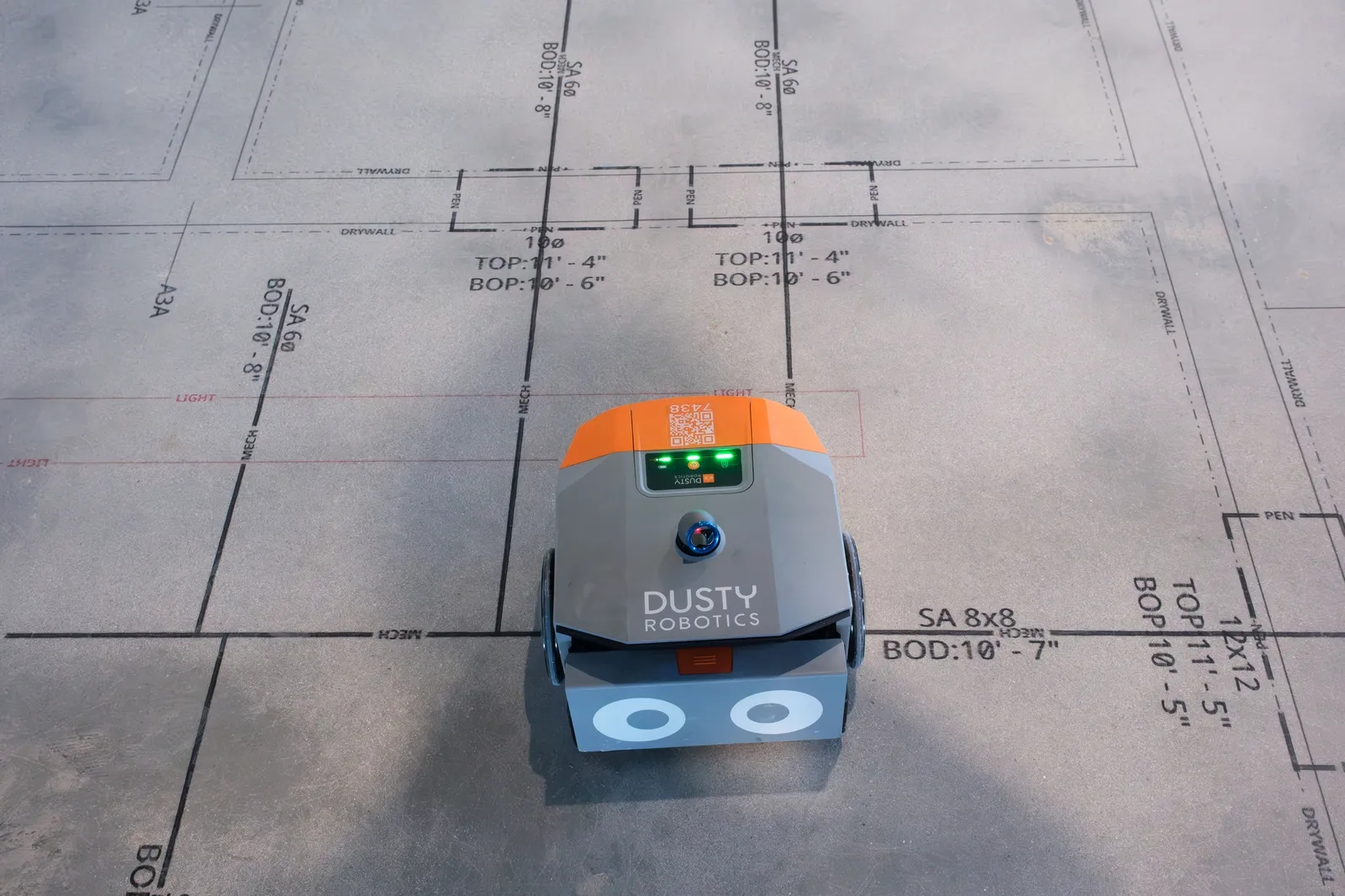
A robotic total station locates points one at a time while a trained operator carries a prism across the floor, staking or marking each one. Automated layout uses a robot that prints the full coordinated model on the slab for every trade in one pass. A total station sets points; automated layout prints the building.
What is a total station, and what makes it "robotic"?
A total station is the surveying instrument that measures angles and distances to locate exact points from a design model. The conventional version takes two people: one sighting through the instrument, one holding the prism. Motors and automatic target tracking make it robotic, so a single person runs the workflow. The operator carries the prism and controller across the floor, the instrument locks on and follows, and each point gets staked or marked in turn. Cutting the crew in half is why robotic total stations replaced conventional ones for construction layout.
What does a robotic total station do indoors?
Indoors, where it competes with automated layout, an RTS locates each point the model calls for and the operator stakes or marks it. Staking sets a physical point: a nail or anchor driven into the slab at the model location. Marking inks the point in crayon or marker, with chalk lines snapped between the points. Control points are usually etched or scribed so they survive the job. Either way the instrument finds the point and the crew connects and interprets it by hand, with line-of-sight required between instrument and prism and a trained operator on the controller throughout.
Leading robotic total station and digital layout tools include Trimble (the RTS Series, run with Trimble FieldLink), Topcon (the LN-series instruments and Topcon Digital Layout software), Leica Geosystems (the iCON iCR70 and iCR80), and Hilti (the PLT 300 and PLT 400-2-R). They vary in price and software, but they share one workflow: a trained operator sets points from the model one at a time, staking or marking each, with line-of-sight to the instrument.
What is automated layout, and how is it different?
Automated layout uses a robot that prints the coordinated BIM or CAD model directly on the slab. Dusty Robotics’ FieldPrinter drives the deck on its own and prints the layout in ink at 1:1 scale, including wall lines, penetrations, control points, and text.
The difference is not speed at the same task. A total station makes the point-by-point process faster. Automated layout changes what the field receives. Instead of marked points to connect, crews get the coordinated model itself, printed where they build.
How does control work if you are not using a total station?
Both methods start from the same place. A surveyor locates the original control points on the floor, typically with a total station, and that survey control is what everything else ties back to. Our breakdown of the six ways teams set floor control covers the tradeoffs between them.
What changes is the step after that. With an RTS, the instrument holding control is also the instrument setting every layout point. With automated layout, the FieldPrinter picks up your existing control using the laser tracker that ships with the system, compares measured control against the model, and prints once that checks out. Survey control still governs the job. A total station just is not what places the layout.
Robotic total station vs. automated layout, side by side
Why go beyond a robotic total station for interior layout?
Two things drive the gap, and neither is raw speed.
The first is coordination. An RTS sets one trade’s points at a time, so each trade lays out in isolation, which is exactly where inter-trade conflicts hide until someone hangs steel. Printing every coordinated trade in one pass from a single model forces those conflicts to surface in the model, before anyone builds.
The second is interpretation. Discrete points have to be connected and read by a person, at every point, on every trade. Printing the layout removes that repeated interpretation step, and repeated interpretation is where drift and rework start. For a VDC team, that is the difference between publishing a model and watching it get re-derived by hand on every floor.
“A combined file lets the team lay out all the trades at once. We saved time. Instead of having five different trades each spend a day separately doing layout on the slab, with Dusty, we could do it all in a single day.”

The gap widens on dense, prefab-heavy, multi-trade work, where point-by-point layout cannot keep up with the volume.
Where does a robotic total station still make sense?
An RTS is the right tool for plenty of work, and automated layout does not replace it everywhere. Total stations own control networks, verification, as-built capture, and exterior or civil site layout. Staking carries a real advantage of its own: a driven nail or anchor leaves a physical, tactile point a crew can pull a string or tape from, and it holds up in wet or high-traffic conditions that would scuff a printed mark. Most teams run both, with the total station on control and verification and the robot on the high-volume interior layout that used to bottleneck on operator hours.
What this looks like on a real project
Dense MEP and equipment layout is where the difference shows up most. Align, which designs and builds data centers, laid out a 15,000 square foot room in one day with two people, a reduction of 784 person-hours that let 18 people stop marking floors and get back to installing. On its data center work the team installed 384 racks across six rooms, 2,304 racks in total, where Dusty held the 1/16 inch tolerance the prefabricated materials required.
Key facts
- A robotic total station sets points one at a time, staked or marked, with a trained operator and line-of-sight. Automated layout prints the full coordinated model autonomously, with no line-of-sight required.
- Survey control is set the same way for both. Dusty picks up that existing control with its laser tracker and verifies measured against modeled before printing.
- The FieldPrinter prints at 1/16 inch accuracy and reports per-trade layers and as-built data through the Dusty Portal.
- RTS effort scales with operator hours and headcount. Automated-layout effort scales with deck access and project scope.
- A total station is still the right tool for control networks, verification, as-builts, and exterior or civil layout. Most teams run both.
Frequently asked questions: automated layout vs. robotic total stations
What is the difference between a total station and a robotic total station?
The difference between a total station and a robotic total station is how many people it takes to run. A conventional total station needs two: one aiming the instrument, one holding the prism. A robotic total station adds motors and automatic target tracking, so a single operator carries the prism and controller while the instrument locks on and follows. The underlying measurement is identical; the “robotic” part is the one-person, motorized, remote-controlled workflow. Nearly all construction layout uses the robotic version, because it cuts the crew in half.
Is the Dusty FieldPrinter a robotic total station?
The Dusty FieldPrinter is not a robotic total station. A robotic total station sets points one at a time, staking or marking each, with a trained operator on the controller and line-of-sight to the prism. The FieldPrinter is an autonomous layout robot that drives the slab and prints the full coordinated model at 1:1 scale rather than discrete points. It picks up floor control with Dusty’s laser tracker and verifies that control against the model before printing. The RTS locates points; the FieldPrinter prints the layout.
Do I still need a robotic total station if I use Dusty?
Most teams using Dusty still need a robotic total station, but for far less work. A total station remains the right tool for establishing control networks, verification, as-built capture, and exterior or civil site layout, and a surveyor typically sets the original floor control with one before Dusty ever prints. Automated layout takes over the high-volume interior layout that used to consume operator hours. It is less a rip-and-replace decision than a question of matching each tool to the work it does best.
Which is faster for interior layout, automated layout or a robotic total station?
For interior layout, automated layout is faster than a robotic total station in almost every case. RTS output is bounded by operator hours and fatigue, because a person sets and marks every point in sequence, one trade at a time. A layout robot prints continuously and covers every coordinated trade in a single pass, so layout that ran as weeks of sequential trade-by-trade marking compresses into days. The fewer the points and trades, the closer the two run; the denser the work, the wider the gap.
Is automated layout accurate enough to replace robotic-total-station layout?
Automated layout is accurate enough to replace robotic-total-station layout for interior work. The FieldPrinter prints at 1/16 inch accuracy and verifies measured control against the model before printing, so crews build directly from what is on the floor. Control networks and as-built verification still run through a total station. In practice automated layout takes the interior layout job while the total station keeps the control and survey work.