
Data Center Construction Labor Shortage: What It Does to Layout

Data center projects are short of people, and layout is where that shortage does the most schedule damage. Associated Builders and Contractors projects the industry needs 349,000 net new workers in 2026. Automated layout changes the crew math directly: on one data center build, Align cut layout labor by 98% and saved 784 layout person-hours.
How bad is the labor shortage on data center construction?
The labor shortage is bad enough that it now shows up as schedule risk rather than as a hiring problem. ABC's January 2026 projection puts the 2026 gap at 349,000 net new workers, with a further 456,000 needed in 2027.
Mechanical trades are the tightest spot, which matters because mechanical rough-in sits on the critical path for energization. In the August 2025 AGC/NCCER workforce survey of 1,342 firms, 79% of companies that employ mechanics said those positions are hard to fill, and 45% reported project delays tied to workforce shortages.
Procurement pressure compounds it. Christopher Gorthy of DPR told Data Center Dynamics in June 2023 that mechanical and technical supply chain lead times run two to three times longer than they used to. When a crew shortage and a long-lead equipment window land on the same project, there is very little float left to absorb a layout error.

Layout on a data center floor has to land under equipment that is already spoken for.
Why does layout absorb the shortage first?
Because layout gates the trades behind it, and it is one of the few labor line items a contractor genuinely controls.
A conventional layout crew is two or three people working from 2D sheets pulled off a coordinated model. That crew has a hard ceiling on how much floor it can measure and mark in a day, and no amount of schedule pressure raises the ceiling. Add a verification pass to check the marks against the model and the same footprint gets walked twice before any pipe or hanger goes in.
On a dense data center floor the ceiling binds harder. Hangers, sleeves, equipment pads, and hundreds of penetrations all have to land where the coordinated model says. Every hour spent measuring is an hour the pipe and conduit crews wait.
One operator drives the FieldPrinter on an active deck while other crews keep working around the column beside it.
What does automated layout change about the crew math?
It moves the marking work off the crew and onto the robot, so headcount stops being the constraint on coverage.
The FieldPrinter reads the coordinated Revit or AutoCAD model through Dusty's plugin, then prints the layout full-scale onto the slab at 1/16″ accuracy and 600 DPI. One operator runs it. Because the print comes from the coordinated multi-trade file, mechanical, electrical, and plumbing marks land in the same pass rather than in three separate mobilizations.
Dusty publishes a working range of 10,000 to 15,000 square feet per day with a single operator. That is the figure to hold against your own crew's daily coverage.
Consolidating the passes is where the schedule saving is largest, because it removes mobilizations rather than shortening them.
“A combined file lets the team lay out all the trades at once. We saved time. Instead of having five different trades each spend a day separately doing layout on the slab, with Dusty, we could do it all in a single day.”


A peer-reviewed 2025 study in Construction Robotics measured the effect across projects and found a 68% reduction in layout labor hours, 18% fewer layout days, and a 99% reduction in physically straining work. That last figure matters more than it looks: repetitive kneeling and measuring is the part of layout that ages a crew out of the trade.
The output carries information a chalk line cannot. Line styles can embed text such as CONDUIT or DUCT directly in the line, and QR codes print as their own layer, linking to a page in Autodesk Construction Cloud, Procore, Box, or Dropbox.
The FieldPrinter prints mechanical hanger points and their labels straight onto the slab, ready for install.
See what automated layout does to a data center schedule
How does the robot know where it is on the slab?
The FieldPrinter stations itself against the building using a minimum of three control points, measured with Dusty's Laser Tracker at sub-1/32″ accuracy. Once that control is established, no survey experience is required to run the layout. Establishing it in the first place is a separate decision, and Dusty works with whichever method a project already uses, from surveyed floor control to wall-mounted targets to points pulled from a 3D scan. Our rundown of the six ways teams set control covers the tradeoffs.
Before printing starts, Dusty's iPad app shows the operator a comparison of measured against modeled control point positions. A crew can see poor field control and correct the alignment before ink hits concrete rather than discovering the drift two trades later, and nobody with survey training needs to be standing on the floor for that check.
On a working data center floor the robot has to cope with conditions the model never described. AI-driven computer vision recognizes common jobsite obstacles and routes around them without operator intervention, cliff sensors detect slab edges and floor openings, and unmodeled obstacles can be scanned and registered into the print job in real time. It prints within 0.825″ in front of and 1.25″ alongside any wall, obstacle, or slab edge, so column furring and stub-ups get finished by the robot instead of by hand.
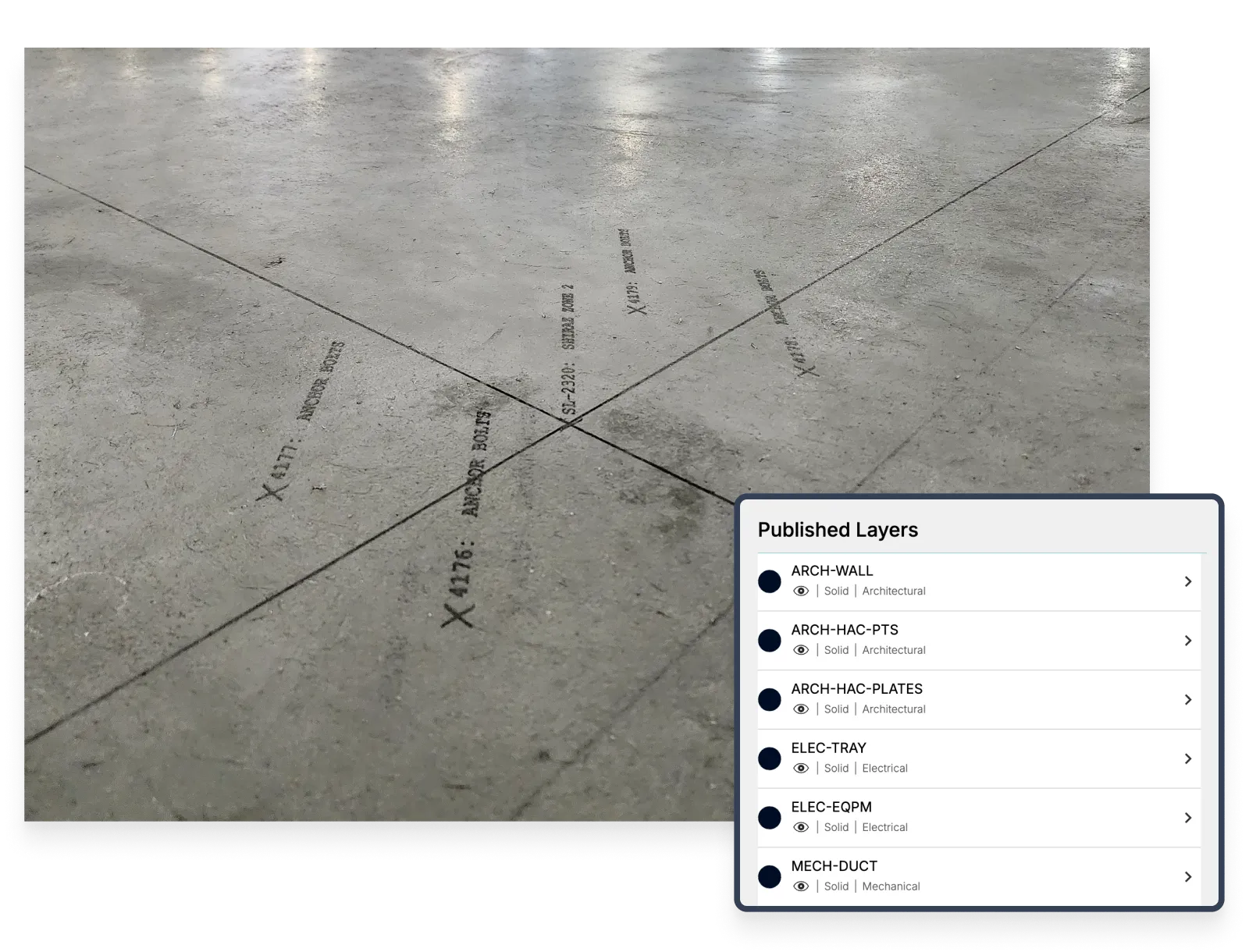
Anchor and rod callouts printed at full scale, with the Portal layers that produced them.
What does this look like on a real data center project?
Align laid out a 15,000 square foot room in a single day with two people, a reduction of 784 person-hours that freed 18 people to get back to installing. On accuracy, Dusty held the 1/16″ tolerance across 384 racks in each of six rooms, 2,304 in total.
“With Dusty Robotics, we were able to reduce the time required for layout from a week to just one long day. What once took 20 people now only requires two.”


The benefit compounds past the layout line item wherever a project leans on prefabrication. On Mortenson's $1 billion, 700,000 square foot two-data-center build, mechanical racks assembled off site had previously been set in place, marked, moved back out, drilled and then reset. Printed anchor positions let the crews install to the marks directly and skip most of that sequence, which is the kind of second-order saving that never appears on a layout line item.
Key facts
| Measure | Figure |
|---|---|
| Print accuracy | 1/16″ at 600 DPI |
| Control points required | Minimum 3, measured at sub-1/32″ accuracy |
| Survey experience needed | None |
| Closest print to an obstacle | 0.825″ in front, 1.25″ alongside |
| Crew to run it | One operator |
| Align, data center build | 98% less layout labor, 784 person-hours saved, 18 fewer crew, 2,304 racks across 6 rooms |
| Mortenson, $1B two-data-center build | 700,000 sq ft; five trades laid out in one day instead of five |
| Measured across projects (2025, peer-reviewed) | 68% fewer layout labor hours, 18% fewer layout days, 99% less physically straining work |
| Dusty scale to date | 300 million sq ft printed, 125+ robots active on jobsites, 500+ jobsite implementations |
Frequently asked questions: data center construction labor shortage and automated layout
How many people does automated layout take on data center projects?
One operator runs the FieldPrinter. That operator replaces the two-to-three-person crew a manual layout pass requires, and because the robot prints every trade from one coordinated file, it also removes the separate mobilizations each trade would otherwise run. On Align's data center build the layout crew shrank by 18 people. The operator role does not require a robotics background or survey training.
Does automated layout require a survey crew?
Not once initial control is established. The FieldPrinter stations to the building using a minimum of three control points measured with Dusty's Laser Tracker at sub-1/32″ accuracy, and no survey experience is needed to operate it. Setting that initial control is a separate question: many projects still establish it with a survey team and a robotic total station, which remains the most common approach. Dusty works with whichever control method a project already uses, from surveyed floor control to points pulled from a 3D scan.
How accurate does data center layout need to be?
Hanger and sleeve locations need to match the coordinated model within a fraction of an inch, because a drifted anchor point clashes with conduit or structure that was already resolved in coordination. The FieldPrinter prints at 1/16″ accuracy and 600 DPI, which is tighter than most downstream trade tolerances. On one Align build that accuracy held across 2,304 racks in six rooms. Where a project has an unusually tight mechanical tolerance, the relevant figure is the rail-offset case: Alston held 1/16″ across an entire jobsite for a robotic system that could not tolerate more than that between rails.
Can a layout robot work on a floor with equipment already installed?
Yes, and that is the normal condition rather than the exception. The FieldPrinter's AI-driven computer vision recognizes common obstacles and routes around them during printing without operator intervention, and obstacles that were never modeled can be scanned and registered into the print job on the spot. The robot prints within 0.825″ in front of and 1.25″ alongside any wall, obstacle, or slab edge, so tight mechanical rooms get finished by the robot rather than hand-completed. It also prints in zones a total station cannot see, which removes the survey-repositioning cycle behind walls and around columns.
Does automated layout reduce the total headcount a project needs?
Automated layout reduces the headcount layout consumes, which is a different thing. Because one Dusty operator covers what a two-to-three-person crew used to, the skilled people freed from repetitive marking get redeployed to coordination and installation, where the shortage bites hardest. The 2025 Construction Robotics study found a 99% reduction in physically straining work alongside the 68% labor-hour reduction, which points at retention as much as at cost. Framing this as replacing a workforce misreads what contractors actually report.