How Automated Layout Supports Prefabrication at Data Center Scale
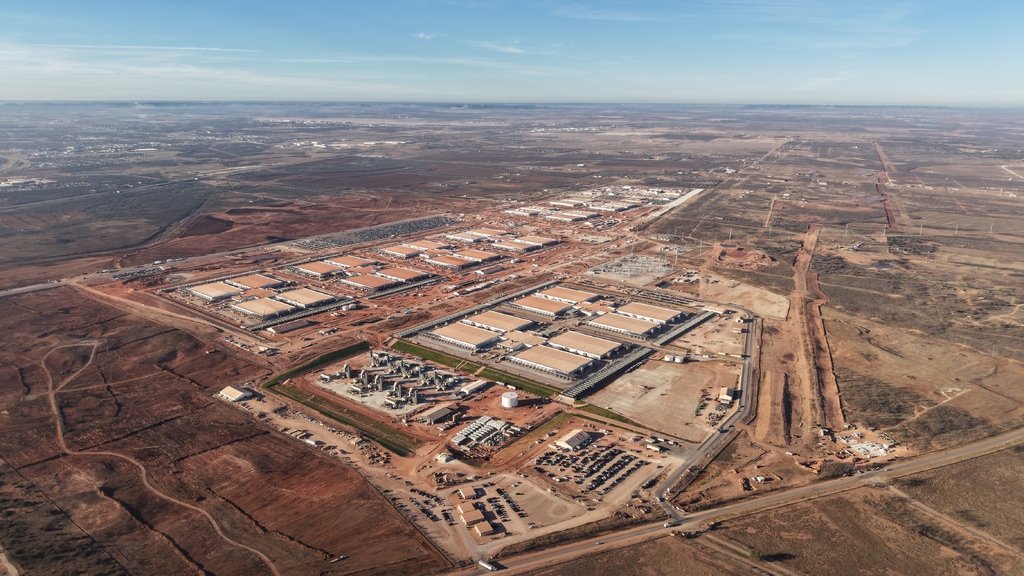

The number that stops people is the turnover rate. DPR is delivering 100 megawatts of capacity a month. The industry benchmark for this kind of work is about 33, which puts the project at roughly three times the going productivity rate. Kaushal Diwan, WND Ventures Leader, did not believe it when he first saw it.
"I looked at that number and thought, 100 megawatts a month, that's crazy," he said. "That can't be right. My initial reaction was that has to be a typo. But that is the true amount of potential capacity."
The pace was not there at the start. DPR built the campus one building at a time and got faster with each one. "Each time we delivered a building, we realized that we can do this faster and faster and faster," Diwan said. "We learned from that, and we use data to help us make better decisions."
Prefabrication carries the schedule, and coordination carries the prefabrication
Two practices are central to how DPR is working at this scale. The first is how much of the work stopped being built on the jobsite. Prefabrication accounts for 20 to 35% of contract value at Abilene, covering electrical and UPS skids, multi-trade MEP racks, wall assemblies, and hot aisle containment. The second is an overall question of coordination: how to keep 9,000 people from 350 companies building from the same information, every day, for years.
Industry research shows that prefabrication alone does not lead to better project outcomes. When FMI surveyed contractors running prefab programs, about a third reported no cost benefit at all. Dodge Construction Network found that only about a third saw their schedules compress by more than 5%.
Both studies point to coordination as an important part of realizing the benefits of prefab. When FMI asked what most needed to change for prefab programs to succeed, the leading answer was design and coordination. Dodge arrived at the same place from another direction, finding that the more a firm used BIM across its portfolio, the more schedule and cost benefit it got out of prefab.
At Abilene, that connection extends to field layout. Prefabrication moves tolerance from the field to the factory. On a conventional job a crew absorbs small errors as it goes, nudging a wall over or moving a conduit run to meet the conditions on the jobsite. But an assembly built to manufacturing tolerance has none of that give in it. It fits or it doesn't.
"Prefab brings manufacturing's level of tolerance to construction," Diwan said. "It's a very high precision type of product. And layout is very important in that. If you're going to take the time to build to super high precision and high tolerance, it fails the moment you laid out incorrectly or install it incorrectly. Then you're going back to rework and giving up some of the efficiency prefab was intended to create."
"Prefab is a very high precision type of product. And layout is very important in that. If you're going to take the time to build to super high precision and high tolerance, it fails the moment you laid out incorrectly. Then you're going back to rework and giving up some of the efficiency prefab was intended to create."

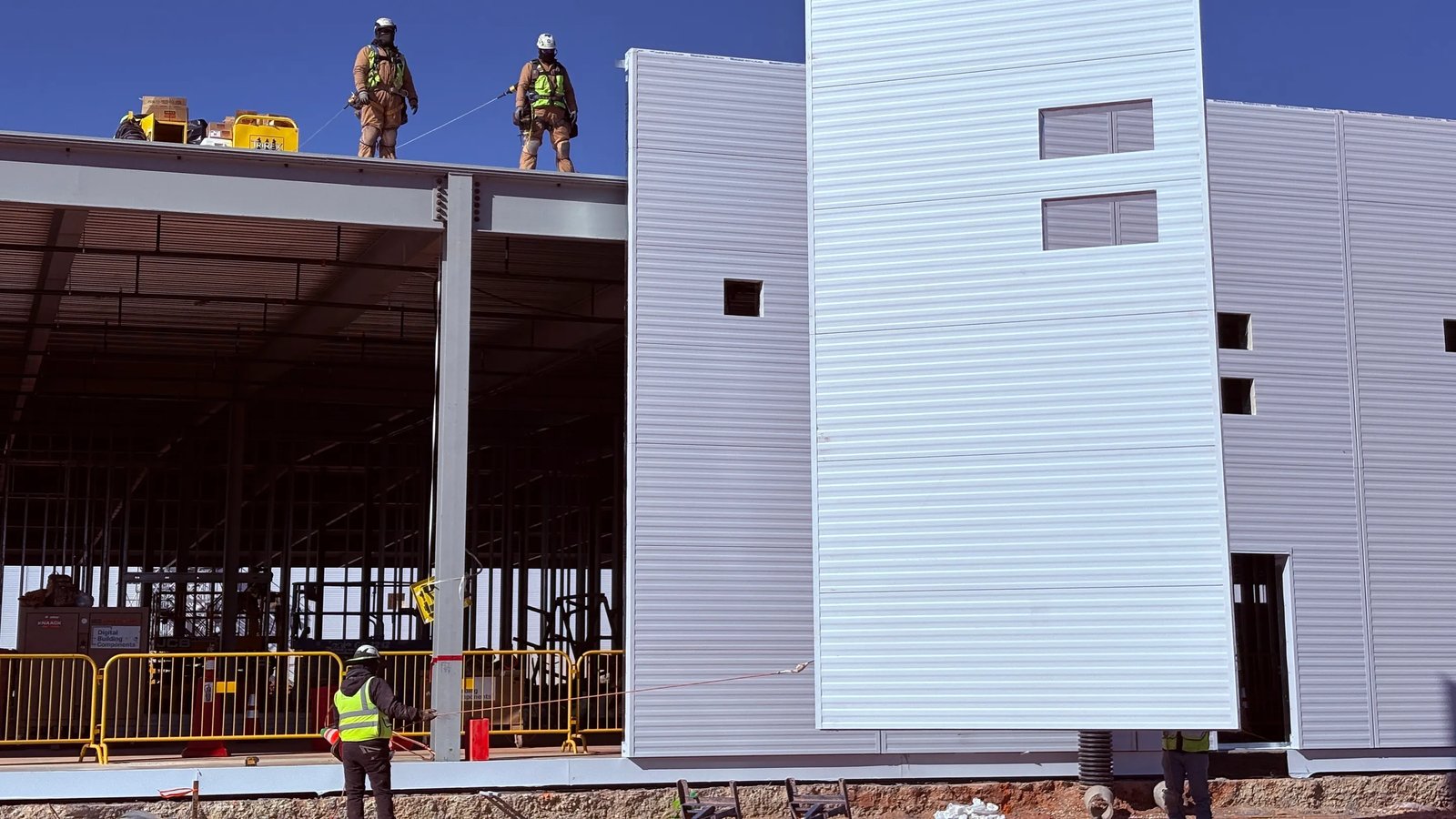
"This is especially true with hot aisle containment systems for data centers, where you don't have a lot of room for adjustment," Diwan said. "Layout becomes a very critical component." HAC assemblies arrive at the data hall complete, and their structural posts have to land exactly as they were modeled.
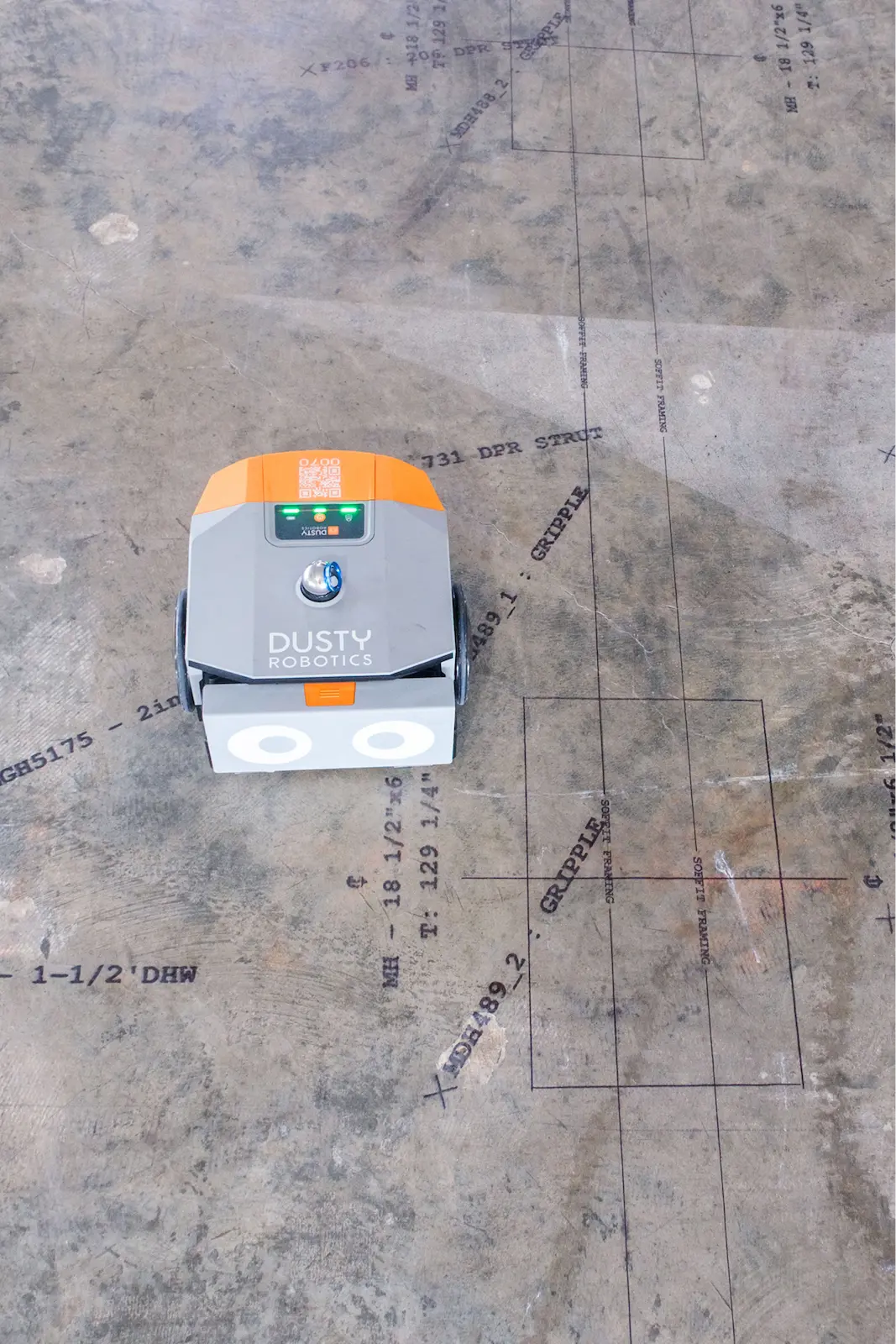
So DPR lays out the post locations using Dusty. Marshall Peterson, who leads DPR's field technology group for the Central Region and for Abilene, describes what goes on the floor. "We print the feet and post locations throughout the data hall to aid installation," he said. That is the chain the whole strategy runs on. Design and coordinate for prefab from the beginning, fabricate to exacting tolerance, and then lay out onsite from the same model. Get the last step wrong and you risk some of the efficiency created upstream.
"Layout basically sets the stage for how prefab gets installed," Diwan said. "And if layout's done incorrectly, now you're talking about rework. Robotic layout has helped us reduce manual layout errors and move installation forward faster."
"Layout basically sets the stage for how prefab gets installed. And if layout's done incorrectly, now you're talking about rework. Robotic layout has helped us reduce manual layout errors and move installation forward faster."
Layout is the one language every trade on the campus reads
At Abilene's scale, layout also helps carry coordinated information to the thousands of people executing the work in the field.
On any given day the Abilene campus holds that vast workforce who communicate in at least five languages. No meeting holds all those people. No drawing set gets read the same way by all of them. The coordination that happens in a model is real work, but it only counts if it reaches the person with the tools in their hands.
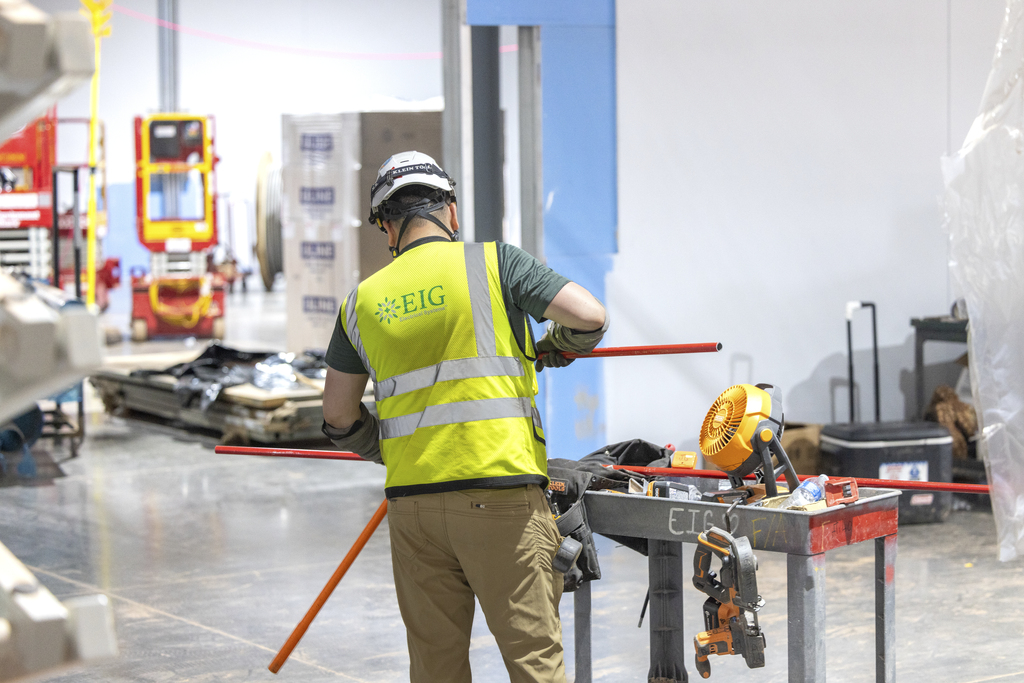
"We have about 9,000-plus workers, 350-plus companies on site," Diwan said. "They've got five different languages being spoken on site. You can't include every one of these workers or companies in the same meeting discussing how one of their systems will interact with somebody else's system. But they will see it on site once it's laid out. And so the layout becomes this common language that everybody understands. They understand their part in it, they understand what's required and then expected of them."
Which is why DPR treats layout as a key strategic capability. "Automated layout is not just about printing," Diwan said. "It's about the design and coordination. We're spending weeks and weeks trying to coordinate buildings. Layout is how we carry that coordinated information into the field."
"We have about 9,000-plus workers on site. They've got five languages being spoken. Layout becomes this common language that everybody understands."
Lay out prefab scopes before the assemblies arrive.
Accurate layout that arrives late is still a bottleneck
Accuracy was never the only requirement. A fast-moving project cannot wait on its own layout, and the volume at Abilene was not trivial. Dusty has laid out roughly 47 miles of line work across the campus, about a third of a mile of layout every working layout day.
That kind of scale makes layout a wholly different job, not a bigger version of the same job. Diwan compares it to a project he did on his own time, putting up a small outdoor bar in his backyard from a kit.
"Here I am snapping lines on my knees, and my back's hurting," he said. "And I'm like, 47 miles of linework? Can you imagine laying out that much linework manually while maintaining the accuracy the installation requires?"
"47 miles of linework. Can you imagine laying out that much linework manually while maintaining the accuracy the installation requires?"
At that volume, manual layout creates serious labor, time, and accuracy demands. "This volume of layout can place a lot of physical and mental strain on field teams," Diwan said. Crews would have spent the project on their hands and knees, and every foot of it would carry the chance of an error nobody finds until something physical refuses to fit.
The schedule challenge is equally difficult. Prefabrication compresses installation, which means the crews waiting on layout are moving faster than they used to. The layout becomes the thing everyone else waits for.
DPR's answer is timing. They use Dusty to print during what would normally be schedule downtime: the slab curing period before trades and equipment can mobilize in force. At about 20 pounds, Dusty's robot is barely heavier than a power tool. It can access the slab when larger crews and heavier equipment cannot.
"By leveraging Dusty layout for interior wall layout, we can print on the slab following concrete placement but before trades and equipment can get on the slab due to curing time," Peterson said. "We are usually on the slab at the same time they're saw cutting slab joints. This way, as soon as the slab is turned over to interiors they can jump straight into installation."
"By leveraging Dusty, we can print on the slab following concrete placement but before trades and equipment can get on the slab due to curing time. As soon as the slab is turned over to interiors they can jump straight into installation."

That matters because prefabricated assemblies and equipment arrive against a date set months earlier.
"There's a date that we're working towards. We call it the ROJ date, the required-on-jobsite date," Diwan said. "So when these assemblies arrive on site, you have to hit that date for layout. If you don't, that's when delays start happening. That's the worst thing that can happen to the job site. We have to make sure the layout is accurate, so that when assemblies are up on site, we can go on day one."
Multi-trade layout connects coordination to installation
Each trade still owns its own layout. They deliver it digitally, starting from the coordinated model and deciding exactly what they need to print for their scope of work. DPR takes the layout data each trade provides, combines it into a single file with Dusty Portal, prints it with Dusty's robot, and hands the floor back to the trades. They check the print to make sure it's accurate to their digital layout, and install.
"The respective trades own their layout," Peterson said. "We support their layout with Dusty and often can combine data from multiple trades which can help find conflicts before installation."
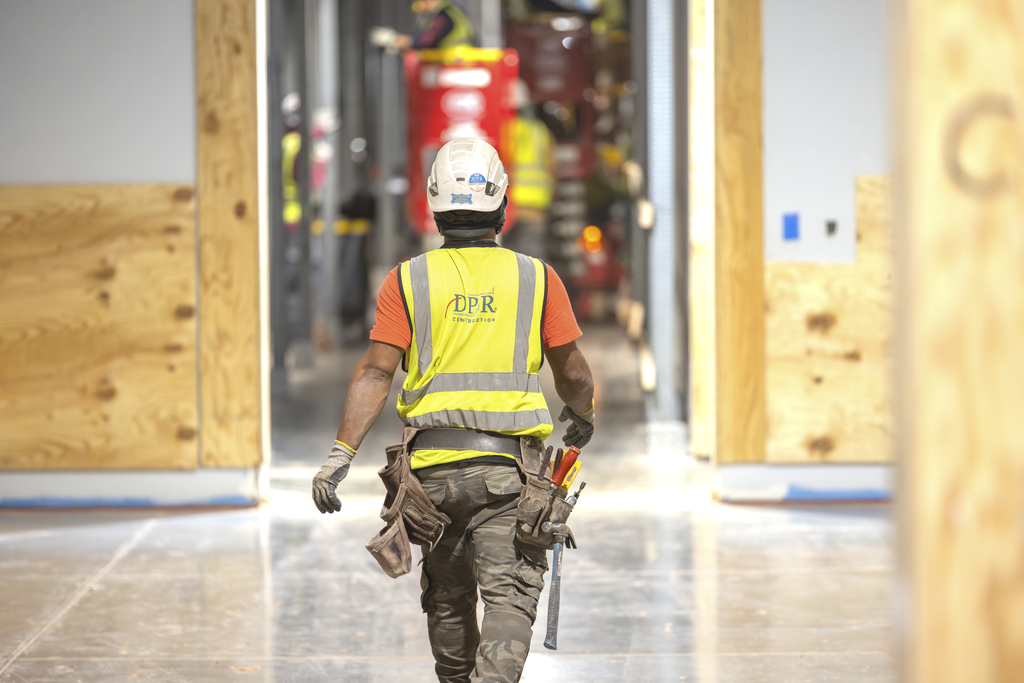
Combining the files turns out to be worth as much as printing them. Merging every trade's data into one layout is a second coordination pass, run against the same geometry at a different moment, and it catches what the model review missed. "When coordinated properly, robotic layout allows all trades to be printed at the same time which can help identify issues that were not caught in model coordination," Peterson said.
There is an upstream effect as well: A print has a date, and the data has to be ready for it. "Leveraging Dusty helped force coordination earlier because the data had to be ready for printing," Peterson said.
At Abilene, the value of layout extends beyond printing lines on the floor. It is one part of a larger system connecting design, coordination and prefabrication to the people installing the work in the field.
"Aligning thousands of people around a common plan, that's what layout does. Layout is a language that everyone understands," Diwan said.
Put Dusty on your next data center project.
DPR Construction is a forward thinking, self-performing general contractor that specializes in complex, technical projects, ranked No. 7 on ENR's 2026 Top 400. In Abilene, Texas, DPR is building a hyperscale data center campus for Crusoe Energy: 1,200 acres, ten buildings, nearly six million square feet.
Interested in learning more about the
Dusty FieldPrinter?