F.L. Crane Took Ownership of Multi-Trade Layout on a 600,000 SF Hospital
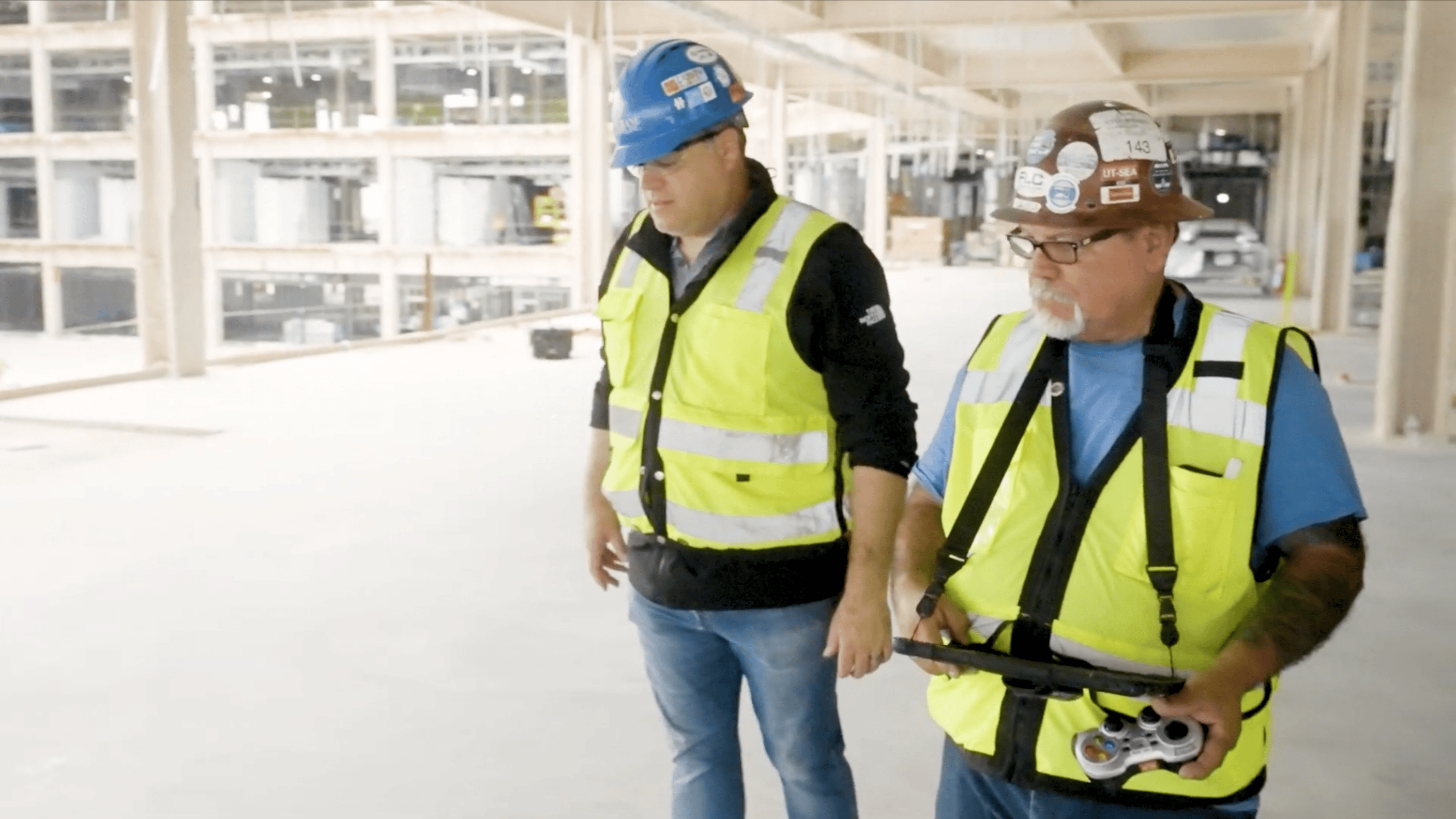

Traditionally, general contractors have treated layout as someone else's problem.
The conventional logic goes like this: each trade is responsible for laying out their own scope. They do it independently, with no formal coordination between trades, and the GC stays as far away as possible on the theory that distance protects them from liability.
But a growing number of GCs are partnering with leading framers to rethink this. They're recognizing that traditional layout creates far more risk than it mitigates. When trades lay out independently, errors compound and conflicts emerge — often after material is already staged and work has begun. Rework is expensive, schedule delays are expensive, and the GC ends up absorbing the consequences anyway.
That's why framers and GCs are driving multi-trade layout as the superior workflow.
Multi-trade layout replaces traditional layout with a coordinated, collaborative, and technology-driven process. Trades work together during VDC to coordinate a combined layout as a digital deliverable. That coordinated file, reviewed and signed off by every participating trade, is then printed full-scale onto the jobsite floor by Dusty in a single, fast pass. Every trade's scope, from the same source of truth, aligned and visible to anybody on the jobsite from day one. The result: faster layout, fewer field conflicts, and efficient installation schedules that move with confidence instead of friction.
But the process needs a leader, and that's exactly the role F.L. Crane stepped into on the UHS Retama project — a 600,000-square-foot hospital tower in San Antonio.
Ready to lead multi-trade layout on your next job?
It's a role that plays to framers' natural position on a project. Framers are first on the slab, highly experienced at layout, and their scope of work sets the stage for every trade that follows. MEPs penetrate framed walls, the plenum coordinates at the ceiling, and every trade operating in the interior ultimately intersects with the framing — which makes the framer a natural anchor for a coordinated layout process. Jeremy Alvis, Division President for Operations Technology at F.L. Crane & Sons, sees that centrality as an opportunity.
F.L. Crane Bet on Doing Things Differently
F.L. Crane & Sons is a fourth-generation, employee-owned specialty contractor with about 430 employees across the Southeast, from Texas to Florida and up to Tennessee. Ten years ago, the company was just getting started with BIM. Today, under president Ty Crane's leadership, Jeremy Alvis' Operations Technology team and FLC's Offsite Manufacturing run prefabrication at scale and lead multi-trade layout on some of the region's most complex builds.
Prefab and layout are inseparable in F.L. Crane's model. For prefabricated wall panels to be installed without friction, they need to match up to a layout that offers the same level of precision and accuracy that the factory-based fabrication process produces. As the number of projects wanting to utilize these prefab services increases, the margin for error with just-in-time delivery shrinks.
"The projects are going up at such a quick rate that the amount of guys you'd have to have on site to lay that job out in time for panels to come right behind… it's significant," Alvis said. "And so Dusty is able to get in, set up, and go."
"The projects are going up at such a quick rate that the amount of guys you'd have to have on site to lay that job out in time for panels to come right behind… it's significant. And so Dusty is able to get in, set up, and go."


Other Trades Quickly Embraced the New Workflow
Multi-trade layout is a workflow, not just a piece of equipment. The pivotal moment is digital coordination: getting every trade to agree on a shared scope, submit layout files based on the coordinated model, and review the federated layout together — before a single line is printed on the slab. That requires real change management.
Change usually meets with resistance in construction, but in this case it was short-lived. As soon as F.L Crane started printing onsite with Dusty, interest from the other trades was strong and dynamic. The value of the workflow and the quality of the print was immediately evident, and the impact on production efficiency was immediate. Other trades' interest was so strong, in fact, that some areas had to be reprinted as trade partners who had initially been skeptics raised their hands to participate in the workflow.
"Utilizing Dusty for multi-trade layout guarantees that all the trades are laid out on the same control system and jive in their accuracy," Alvis said.
"Utilizing Dusty for multi-trade layout guarantees that all the trades are laid out on the same control system and jive in their accuracy."
Multi-Trade Layout and Prefabrication Drove Months of Schedule Compression
On UHS Retama, F.L. Crane replaced two layout crews running total stations (which is what it used to take to stay ahead of fast-paced prefab install) with a single Dusty system, accomplishing the same production throughput in roughly half the time.
The schedule impact was sharper still. A comparable sister project had broken ground about eight weeks earlier. F.L. Crane's build ultimately ran three to four months ahead of that project's pace. Automated, multi-trade layout had unlocked the true production efficiency of their prefab strategy.
The depth of information in multi-trade layout added to the gains. F.L. Crane printed far more than wall track locations: oversized headers, individual stud locations, partition labels, fire-rated wall callouts, and layout for MEPs. All of that was printed in a single coordinated pass, serving every trade working in and around the framing — not just F.L. Crane's crew.
Field Professionals Become More Valuable to the Business
"Between the scheduling, the file creation, and the actual on-site production, there's a lot of skills [field professionals are] able to learn that can take them to that next level," Alvis said. "You're just adding the components of a printer and the accuracies of a total station into one system. It saves their back. It saves their knees. It saves them time."
"Between the scheduling, the file creation, and the actual on-site production, there's a lot of skills [field professionals are] able to learn that can take them to that next level. You're just adding the components of a printer and the accuracies of a total station into one system. It saves their back. It saves their knees. It saves them time."
Layout has historically meant slow, physical, repetitive work for skilled field professionals. Removing that bottleneck while equipping crews with new skills and tools changes the work — and makes a meaningful impact on the business in the ongoing competition for labor.
F.L. Crane Differentiated Their Business with Multi-Trade Layout
For F.L. Crane, multi-trade layout capability has started opening new doors. GC relationships have deepened as the company's ability to lead coordinated layout across trades becomes known on complex projects. The capability draws particular attention from GC BIM leads — people who understand what it takes to coordinate design intent at scale and value a framing partner who can carry that responsibility.
"The accuracy for install goes up over time by including more and more trade partners in the design process," Alvis said.
In the traditional project hierarchy, framers frame. What F.L. Crane & Sons is demonstrating on projects like UHS Retama is that with the right technology, workflow discipline, and early coordination, framers can do something more. They can lead.
F.L. Crane & Sons operates across the Southeast, with offices in Tennessee, Texas, and Florida.
Get Dusty on your next healthcare project.

F.L. Crane & Sons, a fourth-generation employee-owned specialty contractor, took the lead on Multi-Trade Layout for the University Health Retama hospital tower, coordinating framing and MEP layout into a single printed pass and unlocking the throughput of its prefab program.
Interested in learning more about the
Dusty FieldPrinter?




.webp)