
The Contract Language That Makes Multi-Trade Layout Work
.png)
On most jobsites, layout happens four or five separate times — once for each trade, from its own source information, referencing different control, and on its own schedule.
Multi-Trade Layout replaces all of that with a single coordinated layout: every participating trade's content combined early as a digital deliverable and then printed on the slab in one pass with a layout robot like Dusty.
As we discussed in depth in part 2 of this series, Multi-Trade Layout is really a workflow innovation in which layout stops being a string of sequential handoffs, and the conflicts that used to show up as rework in the field show up during coordination instead.
There's a lot to like, and leading contractors increasingly see it as the future. But being sold on the benefits is one thing. Putting it into a contract is another.
Layout is somebody's scope on every project — priced, assigned, and carrying risk. When you move away from conventional practice, it becomes critical that you clarify the workflow you'll follow on paper. Otherwise, instead of a smooth process, you'll get argument, opt-outs, and inflated costs.
Below are two templates you can use to implement Multi-Trade Layout on a real project: contract language for your subcontracts, and a project plan template that goes with it. They come as a single download. They're free. Take them, mark them up, make them yours (please read the fine print*).
Download the Multi-Trade Layout contract templates: the Addendum and the Layout Execution Plan
This post is about what's in them, and why.
Why there are two documents
Here's how these two documents work together:
| Multi-Trade Layout Addendum | Layout Execution Plan | |
|---|---|---|
| What it is | A subcontract exhibit | The project's plan of record |
| What it carries | Roles, duties, what you can rely on, what you must still check | Dates, figures, layers, areas, formats, notices |
| When | Executed at buyout, once | Issued at kickoff, reissued as the job changes |
| Who issues it | The General Contractor, with each subcontract | The Layout Coordinator |
The Multi-Trade Layout Addendum and the Layout Execution Plan are really one instrument in two pieces.
The Addendum answers who does what and what you can count on. This is the information you can establish during buyout, when the contract is executed.
But there's a lot of information you can't establish at that time. A list of exactly what content each trade will lay out, due dates, tolerances, file formats, areas and layers, shared coordinate references — the Layout Execution Plan holds all that information. We go into detail about the Kickoff Meeting and the commitments you want to get out of that meeting in part six of this series. The Layout Execution Plan is just a template document that allows you to capture those commitments in writing. The Plan gets created and distributed following the Kickoff Meeting, which happens after the contract is signed.
As clear as the benefits of Multi-Trade Layout are, you wouldn't be doing your job if you didn't have one eye on the risks of moving to a new workflow. But this is the construction industry. We manage risk with clear and fair contracts. In this post, we'll walk through the common concerns with Multi-Trade Layout and how the Addendum and Layout Execution Plan address them.
Seven questions this post answers:
- Does a GC have to self-perform layout to lead Multi-Trade Layout?
- Who owns layout risk when one party prints for every trade?
- Does Multi-Trade Layout conflict with existing subcontract layout clauses?
- How accurate is robotic layout, and who is accountable for accuracy?
- Can a general contractor require subcontractors to use automated layout, or is that a means-and-methods directive?
- Does a subcontractor lose control of its own layout in Multi-Trade Layout?
- How do you recover layout costs already priced into subcontracts?
Does a GC have to self-perform layout to lead Multi-Trade Layout?
No. Most general contractors running Multi-Trade Layout don't self-perform layout, and many don't run the robot either. Multi-Trade Layout separates four roles — Layout Coordinator, FieldPrinter Operator, Control Surveyor, and the party holding the agreement with Dusty Robotics — and each one can be assigned to the general contractor, to a participating trade, or to a third party.
Here's the concern that sits behind that question:
GC's perspective: We're construction management at risk (CMAR). Every subcontract we write puts layout on the sub, and that's important because it creates accountability for getting it right.
Trade's perspective: We lay out our own work every day, and we're happy to. What we don't want is to be on the hook for laying out someone else's scope.
Those sound like opposite positions. They're the same one: I'll own what's mine, and I don't want to inherit what isn't.
Fair. But Mult-Trade Layout doesn't change that. Accountability can be separated from activity. And there's precedent for this with VDC: GCs and trades work together to coordinate the model, but that doesn't mean they accept design liability.
The Addendum begins with the Project Configuration table, which establishes roles, because this is at the heart of a successful Multi-Trade Layout process. Four clear and distinct roles that can be separated or combined given the needs of the project:
- Layout Coordinator: coordinates the preparation, combination, and publication of the layout content.
- FieldPrinter Operator: operates Dusty in the field to produce the layout onsite.
- Party holding the agreement with Dusty: holds the contract with Dusty and makes the solution (all the hardware and software that make up Dusty's FieldPrint Platform) available to the rest of the project team.
- Control Surveyor: establishes project control for each area to be laid out.
This is where the decisions about who leads the process or who runs the robot (discussed in this blog post) stop being a conversation and become a matter of record. Here are the common best-practice approaches to role assignment:
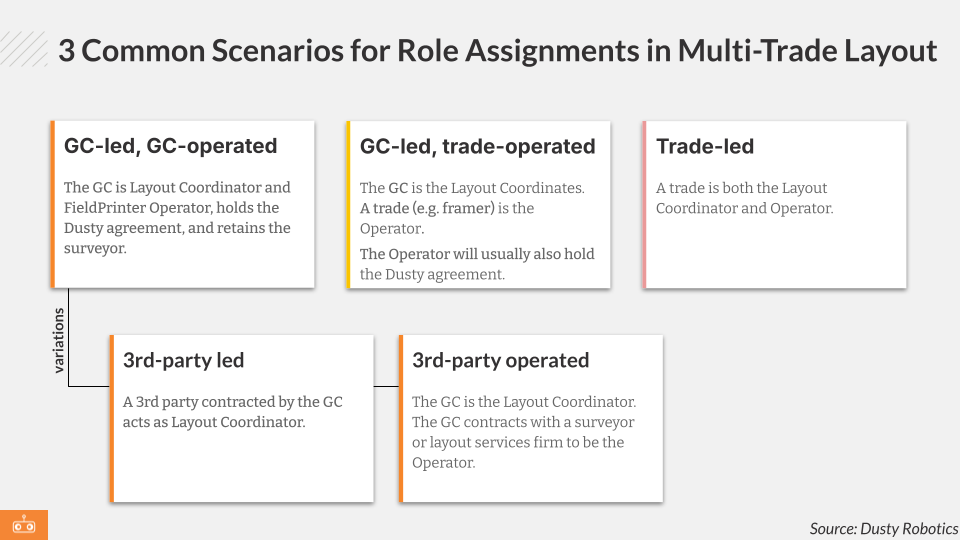
Who owns layout risk when one party prints for every trade?
In Multi-Trade Layout, accountability for layout content follows the file prep, not the printing. Each trade still owns its own layout content, and they're responsible for getting it right. The FieldPrinter Operator owns only whether the print matches the approved file. The Control Surveyor owns the control. Printing another trade's content does not transfer that trade's responsibility for it.
Here's how the concern gets voiced:
GC's perspective: Today, if a wall lands in the wrong place, the sub who laid it out is accountable for the error. If we start getting involved in layout, does that change? Now if there's a layout error, is it our risk?
Trade's perspective: We're comfortable laying out our own work. But if we're the ones operating the robot when it's laying out another trade's stuff and something's off, is that now our fault?
How the workflow behaves
- Each trade prepares and uploads its own file. They own correctness and completeness of that content. Nobody edits anybody else's. The Layout Coordinator is a quarterback, not an editor.
- Every trade reviews the Combined Layout and approves its own scope, in writing. Nothing prints in an area until everyone with content in that area has approved their part of it, or has had a real opportunity to on the dates the Plan sets.
- The operator prints the combined layout with Dusty. All the robot does is reproduce each trade's content on the floor. Everybody still owns their own layout because it came from their own file prep.
- The superintendent walks the print with every trade, on the floor, before anybody installs anything.
We go deep on per-trade file encapsulation, and how it allows for distribution of accountability instead of pooling it, in this post. The Addendum is what makes these principles stick.
Three things can go wrong
There are three distinct types of layout risk:
- The layout content: does the model fit the site, is the scope right, is it current with the latest revisions and approved RFIs? Who owns the risk: the trade that authored the content.
- The control: is the project control accurate and is it where it says it is? Who owns the risk: the Control Surveyor named in the table above.
- The print: did the robot put the marks where the file said? Who owns the risk: the FieldPrinter Operator.
There's no new risk
Not only are those three key types of layout risk covered by a responsible party, Multi-Trade Layout doesn't add any new risks. But it may surface exposures you're already carrying and currently can't see (and that's a good thing).
Normally, the framer might pull off a column line. The mechanical contractor works from control they shot themselves. Somebody else measures off a window mullion. Four trades lay out the same floor from four references, on four different days, and nobody finds out they disagree until the work is installed.
That risk is on the job right now. It just doesn't have a name, it's impossible to discover it early, and there's no clear accountability for it. Multi-Trade Layout changes that.
"Utilizing dusty for multi trade layout guarantees that all the trades are laid out on the same control system and jive in their accuracy."


How the Addendum manages risk
Authorship never moves.
Addendum §1.7 Trade Layout Content — layout content authored by or for a Participating Trade for inclusion in the Combined Layout. Content on the Layers designated to a trade in the Layout Execution Plan is that trade's Trade Layout Content, whoever drew it and whatever file it was delivered in.
Your content stays yours even if a third-party consultant drew it, even after it's combined with five other trades. Layers are the boundary — and Layer is a defined term in the Addendum, so it means the same thing to everyone. The Plan is where each trade's Layers get designated.
Everyone is responsible for the correctness and completeness of their own layout.
Addendum §2.7 Each Participating Trade is responsible for its own Trade Layout Content including: contents, accuracy, coordination with the appropriate models and shop drawings, and adherence to current revisions and approved RFIs. No other party is responsible for the accuracy or completeness of a Participating Trade's Trade Layout Content.
Trades sign off on their own work, not anyone else's.
Addendum §2.7.3 No area shall be printed until every Participating Trade whose content appears in that area has approved the Combined Layout or has had the reasonable opportunity (per the Layout Execution Plan as applicable) to approve the Combined Layout.
As a trade, when you approve the Combined Layout, you're approving only your own content — approving doesn't make you responsible for another trade's work, and it doesn't relieve you of responsibility for yours.
Note the second half of that section. Every trade gets a real chance to review before its area prints — but a trade that sits on the file doesn't get to stop the job. Those dates come from the Layout Execution Plan, which is one more reason the Plan is worth filling out carefully.
Before installing, every trade still has to verify the print: each is responsible to confirm the print agrees with control, check the dimensions its scope depends on, and verify existing conditions. But the process is fair to trades who meet those responsibilities:
Addendum §3.5 A Participating Trade that performs these checks is not responsible, under this Addendum, for a discrepancy between the Printed Layout and Project Control or the contract documents that those checks would not have revealed.
Download the Multi-Trade Layout contract templates: the Addendum and the Layout Execution Plan
Does Multi-Trade Layout conflict with existing subcontract layout clauses?
No. When you fill out the Layout Execution Plan, you define the exact scope handled under Multi-Trade Layout. Anything outside of that is handled conventionally. So you don't risk any ambiguity or gaps.
GC's perspective: Our subcontract already says the sub does their own layout.
You have a form subcontract. It's been through your legal department. It puts layout on the subcontractor. What happens to that clause?
The clause stays, and it keeps working. The Addendum is a scalpel, not a hammer:
Addendum §1.3 Any provision of the Subcontract that assigns layout of the Work to Subcontractor, or that makes Subcontractor responsible for the accuracy of that layout, does not apply to layout performed under this Addendum. It continues to apply to all other layouts included in Subcontractor's scope of work.
The Addendum follows this pattern of cooperating with the subcontract on other points as well. For example, the Addendum controls on layout method, layout content, dimensional authority, and what a party may rely on the layout for. Your subcontract controls everything else — payment, schedule, indemnity, insurance, all of it, untouched.
And it flows down. The General Contractor includes the Addendum with every participating trade, and each trade includes it with any lower-tier sub whose scope is in the print. One instrument with the same terms for everybody.
How accurate is robotic layout, and who is accountable for accuracy?
Automated layout with Dusty Robotics prints exactly what's in the approved file, aligned to best-fit the control you give it. If the content is wrong, the print is wrong — accurately. If the control is off, the whole print is off. If the operator operates it incorrectly (for example, stations it badly and prints anyway), the print will be in the wrong place.
But get those three things right, and the FieldPrinter places layout to within a sixteenth of an inch, every time. Even better, each of those factors contributing to accuracy has a direct owner in Multi-Trade Layout.
This concern is driven by the craft:
Trade's perspective: I've been laying out my own work for twenty years. Why should I trust a machine with it?
Under the Multi-Trade Layout Addendum, the FieldPrinter Operator commits to a standard of performance:
Addendum §3.1 The FieldPrinter Operator shall operate the FieldPrinter in accordance with the manufacturer's published operating procedures and standards, so as to produce the Printed Layout within the dimensional tolerances the contract documents require.
Notice what that section does not do: it doesn't drop a Dusty number into your contract. It ties the operator to the dimensional tolerances your contract documents already require. Your project's tolerances are your project's, and the Addendum simply requires that they are observed when producing the layout.
But there are some important limitations that protect the operator and really matter to a foreman:
Bad control is not the operator's fault. The operator isn't responsible for a placement error caused by control that doesn't meet the required accuracy.
The operator can refuse to print. Every time the tracker is stationed, Dusty's iPad app tells you the stationing error. Right away, before anything is printed. If the stationing error is out of tolerance, the operator doesn't print — at least, not without talking to the GC first. Stopping the process like this is expressly not a failure to perform under the Addendum. Nobody gets pressured into printing when they know there's a problem.
None of this changes the accuracy your contract already requires of you. Multi-Trade Layout changes how layout is marked. It doesn't change the tolerances the contract documents demand.
Can a general contractor require subcontractors to use automated layout, or is that a means-and-methods directive?
Requiring a coordinated layout deliverable is not a means-and-methods directive. General contractors already require trade partners to join BIM coordination, attend clash detection, submit in a specified format on a specified platform, and work from project control the contractor established. Multi-Trade Layout asks for the same kind of thing — a layout file, on assigned layers, on a shared coordinate system, by a date. It's about deliverables, not means and methods. How a crew installs the work stays entirely with the subcontractor, and the Multi-Trade Layout Addendum says so in the same section that assigns the coordinating role.
Here's the concern:
GC's perspective: It's a broadly-accepted principle in construction: I can't hire an excavator and tell them which machine to dig with.
But Multi-Trade Layout is about deliverables, not means and methods. It asks for a layout file, on assigned layers, on a shared coordinate system, by a date. That's the what, not the how.
The Addendum makes this explicit:
Addendum §2.2 Assuming the role of Layout Coordinator does not confer authority to direct the Project's means, methods, sequencing, or site logistics, and does not limit the authority or responsibility a party holds in any other capacity.
Being the Layout Coordinator doesn't make you anybody's boss. It doesn't give you the right to tell a trade how to run their crew, what order to work in, or how to stage their material. It's a paperwork job — collect the files, combine them, publish them, schedule the print.
Does a subcontractor lose control of its own layout in Multi-Trade Layout?
No. Each trade authors its own layout content, no other party can edit it, and no other party can be made responsible for it. Nothing prints in an area until every trade with content in that area has approved its own scope in writing, or has had a reasonable opportunity to. What changes under Multi-Trade Layout is when a subcontractor exercises that control — during coordination, rather than out on the slab with a chalk line.
Here's the fear:
Trade's perspective: We've laid out our own work forever. It's a crucial part of our process for delivering quality. It's how we protect our schedule and our margin. Now you want to print it with a robot we don't operate from a file we didn't make? No thanks.
But there's nothing in Multi-Trade Layout that takes control of a trade's own layout away from them. Each trade owns its own layout content, exclusively. There's a potential vulnerability in that protection if every participant in Multi-Trade Layout isn't held to the same set of accountabilities and constraints, but that's what §1.5 is for:
Addendum §1.5 The General Contractor shall include this Addendum in its agreements with every other Participating Trade.
One instrument, the same terms, every subcontract — instead of six separately negotiated conversations in which each trade is asked to trust that everyone else got the same deal.
Once trades understand the file architecture, the workflow, and Dusty's capabilities, a lot of them are glad to hand layout over. The layout gets done right, and it gets done once. But even better, now the trades get visibility to each other's scope of work, they're more aligned, and they can truly accelerate their installation without risk of rework.
"It is so obvious that one party should be doing all the layout for the job. That's not about hoarding ownership — it's the opposite. It's about transfer of information from [Autodesk] Revit to the slab."


How do you recover layout costs already priced into subcontracts?
Multi-Trade Layout works best when it's in the bid documents and executed with the subcontract, because then a trade can see exactly which obligations it is taking on before it prices the work. If the job is already bought out, the mechanism is a change order — potentially a deductive one, depending on how the roles land. On the other hand, if something does go wrong and a trade's content isn't printed, they're protected as long as they met their Multi-Trade Layout responsibilities.
Both perspectives on this question are reasonable worries:
GC's perspective: I've already bought out the trades. Manual layout is already priced into six subcontracts. If we move to Multi-Trade Layout, how do I know we're actually recovering that cost rather than paying for layout twice?
Trade's perspective: How much am I giving back — and what happens to me if this doesn't go the way you're describing and we end up laying it out by hand anyway?
This is a buyout instrument
The Multi-Trade Layout Addendum works best executed with the subcontract, because the Project Configuration table is what tells a trade which obligations it is taking on:
Addendum §4.1 Subcontractor's obligations under the Subcontract include the obligations assigned to Subcontractor under this Addendum, including, where assigned to Subcontractor, procuring access to the FieldPrint Platform and providing personnel to operate the FieldPrinter.
A trade that knows at bid time it isn't carrying conventional layout scope, and is carrying the operator role, or the responsibility for the contract with Dusty, or neither, can price all of that cleanly. A trade asked the same question seven months after their contract is signed is being asked to unwind a number, and that's a harder conversation for everyone.
Which is why the sequence matters more than any clause: decide, then bid, then buy out, then coordinate. We walk through the full timeline in part five of this series: When Does Layout Start? Earlier Than You Think.
"Dusty's technology introduces a process that makes so much logical sense. We're pushing Multi-Trade Layout as the reason to get coordination done early. There's a lot of value [in Multi-Trade Layout] that we can share with the team. Less rework. Predictable schedules, predictable costs."


If you're already past that point
But, as we discussed there, sometimes the ideal is not the reality. Even so, Multi-Trade Layout is worth doing.
If you're still bidding, ask trades to revise with an alternate for automated layout, so the number is visible on both sides rather than assumed.
If you're already bought out, it's a change order — and depending on how the roles land, it may well be a deductive one. That conversation goes better when the roles are written down clearly, so use the Addendum anyway and adopt it via the change order.
Who's left holding the bag if there are issues with Multi-Trade Layout
One thing about construction is for sure: there's always some curveball around the corner that you would never have predicted in your wildest dreams. So here's a fair question: If I price this on the assumption my layout gets printed, and then it doesn't — am I holding the bag?
No. That's what §4.2 is for:
Addendum §4.2 Layout not performed under this Addendum. Where Multi-Trade Layout is discontinued for a Participating Trade's scope of work, or where Trade Layout Content a Participating Trade delivered under the Layout Execution Plan is not printed, that trade's performance of that layout by conventional means is a change under the Subcontract.
Section 4.2 is deliberately not a blank check. It doesn't cover layout the Plan already excludes from the scope of Multi-Trade Layout — those exclusions are agreed in advance precisely so they aren't a surprise. And it doesn't cover content that went unprinted because that trade missed its own delivery or approval date.
But a trade that does its part and then watches the workflow somehow go off the rails is not left absorbing the cost of a decision it didn't make or a circumstance it can't control.
Multi-Trade Layout doesn't change accountability for correct, complete layout
In the end, with Multi-Trade Layout, somebody is being asked to rely on somebody else's work.
That's what a genuinely collaborative workflow feels like from the inside — and you wouldn't be any good at your job if you didn't have one eye on the risk that comes with it.
The good news is that it's a manageable risk, and managing it doesn't require anyone to absorb anyone else's exposure. It just requires the boundaries to be written down.
Your layout content remains yours. It also stays disentangled from others' layout content. You approve your own scope and nothing prints until you do. You can rely on the print, within a stated standard, for what's on it. You still verify before you install. And if the workflow somehow fails when you've held up your end, you're not the one holding the cost.
Multi-Trade Layout is not a redistribution of risk from what is conventional.
Both templates are below, in a single download. We're offering them freely as a starting point based on best practice. Take them to your legal team, mark them up, and make them yours.
Download the Multi-Trade Layout contract templates: the Addendum and the Layout Execution Plan
Some important considerations and a bit of fine print
There are a few things these documents deliberately don't do, and it's worth your own internal legal review to confirm it's not an issue in your situation.
The Addendum carries no cost allocation, no notice mechanics, and no default behaviors, and it routes changes back to your subcontract rather than building its own change machinery. Those are assumed to be handled in your subcontract already.
The Plan carries the notice and reporting process as recommended practice — a table your team can adopt as written, replace, or strike.
And speaking of the Plan, different project teams will want to treat that document differently: you can treat it as a planning and communication document with no binding effect, or modify it into a binding agreement subordinate to the Addendum. That's a call for project leadership and your attorney. See the notes in the Plan for more detail.
Dusty Robotics is not a party to the Addendum. It's an agreement between the GC and its trade partner about how they'll work together. Our commercial relationship with whoever holds the robot lives in a separate agreement and doesn't reach into this one.
*Addendum contract template and project plan template are provided for informational purposes only and are provided "As Is" without any representations or warranties of any kind, express or implied. Dusty Robotics, Inc. disclaims any and all liability for the content of the documents. Use these documents at your sole discretion. Consult a legal advisor prior to modifying or entering into any agreement based upon the content of the provided contract template or project plan template.
Don't miss our next Multi-Trade Layout Best Practices article.
Catch up on our series
This article is #8 in our deep-dive series on best practices for the Multi-Trade Layout workflow powered by Dusty. If Automated Layout is the technology, Multi-Trade Layout is the process, and this series is all about how to do it right. Catch up on the rest of the series below.
Foundations
#1: The Bottleneck That's Costing You Time, Money, and Trust. What's wrong with traditional layout in modern construction?
#2: Multi-Trade Layout: The Construction Workflow That Changes Everything. An introduction to Multi-Trade Layout, how it works, and how it's different.
Workflow Strategy
#3: Four Decisions Every GC Needs to Make to Implement Multi-Trade Layout. Who leads the workflow? What’s in-scope for Multi-Trade Layout? When will all this happen? How will you execute?
#4: What Goes on the Slab? How to Decide Who—and What—Gets Included in Multi-Trade Layout. How to decide what trades to involve. Reimagining what layout can communicate. Deciding what to print.
#5: When Does Layout Start? Earlier Than You Think. How to schedule for Multi-Trade Layout — and what to do when the job is already underway.
Implementation
#6: Inside Multi-Trade Layout: Who Does What, and When. Roles and responsibilities. Who does what, and when.
#7: Field communication starts with layout file prep. So does risk management. You can print anything, but it doesn't mean you should print everything. How to make good decisions about what to print while managing layout accountability.
#8: The Contract Language That Makes Multi-Trade Layout Work. (You're reading it!) Includes free, downloadable contract templates for Multi-Trade Layout: a subcontract Addendum and a Layout Execution Plan. Walks through how they work and how they address the real concerns of GCs and trades considering Multi-Trade Layout for the first time.